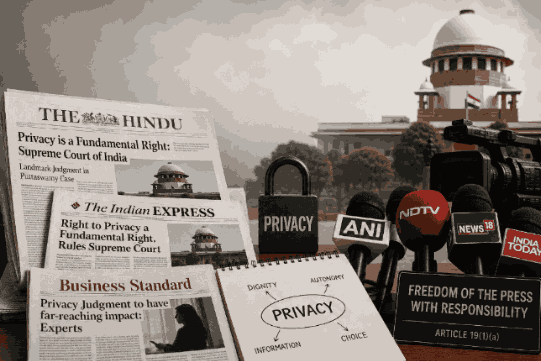
The media’s freedom to publish versus the individual’s right to privacy. Both are constitutionally protected. Neither is absolute. And Indian courts have spent nearly three decades working out, case by case.
Supreme Court’s early reluctance to even recognise a right to privacy.
Constitution & Press
The press in India doesn’t have a special, standalone freedom.
Its right to publish flows entirely from Article 19(1)(a): the ordinary citizen’s freedom of speech and expression; a point the Supreme Court made firmly in Bennett Coleman & Co. v. Union of India That freedom is subject to “reasonable restrictions” under Article 19(2), which explicitly lists decency, defamation, and contempt of court as valid grounds for reining it in.
Right to Privacy, doesn’t appear anywhere in the text of the Constitution. It had to be read into Article 21, the right to life and personal liberty and that took the Supreme Court a surprisingly long time to do unambiguously.
Act I: The Long Doubt
For decades, two old decisions loomed over any privacy claim in India. M.P. Sharma v. Satish Chandra, an 8-judge bench ruling from 1954, and Kharak Singh v. State of U.P., decided by 6 judges in 1963, both suggested that the Constitution simply did not guarantee a right to privacy.1 Justice Subba Rao’s dissent in Kharak Singh, which did recognise privacy as part of personal liberty, sat unused for years, a footnote to what was then the majority view.
By the time challenges to the Aadhaar biometric identity scheme reached the Supreme Court in the 2010s, this uncertainty had become untenable. The Court referred the question to a 9-judge bench to settle, once and for all, whether privacy was a fundamental right.
Act II: Puttaswamy Settles the Question
Justice K.S. Puttaswamy (Retd.) v. Union of India (2017) is the case that finally gave privacy its constitutional home.2 Writing for the plurality, Justice D.Y. Chandrachud described privacy as “the reservation of a private space for the individual” — a “right to be let alone,” rooted in individual autonomy and the ability to make choices that are central to being a person. The Court expressly overruled M.P. Sharma and Kharak Singh on this point.
Crucially, Puttaswamy didn’t treat privacy as one single thing. It broke the concept down —
a) bodily integrity,
b) decisional autonomy, and
c) informational privacy,
the strand that matters most for media law, since it concerns control over how personal information is collected, used, and disseminated. And like every other fundamental right, privacy isn’t absolute: it can be restricted by a law that passes a three-part test —
a) legality,
b) a legitimate state aim, and
c) proportionality.
Puttaswamy gave privacy its constitutional legitimacy. But the actual rulebook for how privacy interacts with the press had already been written — 23 years earlier, in a case about a convicted murderer’s memoirs.
Act III: The Auto Shankar Case — Still the Real Rulebook
If there’s one case every media law student in India memorises, it’s R. Rajagopal v. State of Tamil Nadu (1994), better known as the Auto Shankar case.3
Auto Shankar, a prisoner facing trial for six murders, wrote an autobiography from jail detailing his links with corrupt police and prison officials. A Tamil magazine planned to serialise it. Fearing exposure, those officials tried to block the publication before it ever hit the stands.
The Supreme Court’s answer became the backbone of privacy law in Indian media, distilled into a set of broad principles:
- Privacy is implicit in Article 21, and includes the right to keep matters like marriage, family, and health out of the news without consent — true or false — unless the person has voluntarily waded into public controversy.
- Once something is on the public record — including court records — it loses its privacy shield, with one important exception: the identity of a sexual assault victim must never be published, no matter how public the case has become.
- Public officials get far less protection, but only for conduct connected to their official duties, and only if the report was published with reckless disregard for the truth. A journalist who did reasonable verification has a valid defence, even if some details later turn out wrong.
- The State itself cannot sue for defamation. The Court borrowed reasoning from New York Times v. Sullivan and the English case Derbyshire County Council v. Times Newspapers to hold that letting government bodies sue for libel would have a dangerous “chilling effect” on free speech.
- Prior restraint is almost never allowed. Citing the U.S. Pentagon Papers case, the Court held that any attempt to stop a publication before it happens carries “a heavy presumption against its constitutional validity.” If Auto Shankar’s associates felt defamed, their remedy was to sue after publication and not to gag the press in advance.
Nearly every privacy-versus-media dispute since has traced back to this framework, including Puttaswamy itself, which cited Rajagopal approvingly.
Act IV: When the Internet Won’t Forget
Rajagopal was written for an era of newspapers and magazines, which are the publications that, once withdrawn, more or less disappeared. The internet doesn’t work that way, as the Delhi High Court discovered in a deeply troubling 2021 case.
In X v. Union of India, a woman’s private photographs — taken from her social media accounts without consent — were uploaded to a pornographic website by an unknown user.4 The Court ordered the content removed. It kept resurfacing on other sites and mirrors almost as fast as it was taken down. As the judgment memorably put it: “the internet never sleeps; and the internet never forgets.”
Unable to simply order one website to comply, the Delhi High Court appointed a cyber-law expert as amicus curiae5 and worked toward directions that could force proactive filtering, using hash-matching technology to catch re-uploaded copies automatically, rather than making the victim fight the same battle over and over.
India still has no codified “right to be forgotten” statute like the EU’s GDPR,(General Data Protection Regulations) but cases like this are building one, judgment by judgment, out of Article 21.
Act V: Where Privacy Meets Defamation
Privacy and defamation are cousins, not twins. Privacy protects against the disclosure of true but private facts; defamation protects against false statements that damage reputation. In practice, media disputes often plead both together.
Under India’s new criminal code, the Bharatiya Nyaya Sanhita, 2023, defamation is now Section 356 (carrying forward the old IPC Section 499 almost verbatim). It punishes any imputation made to harm someone’s reputation, but with ten built-in exceptions that protect legitimate journalism: truth published for the public good, good-faith opinion on a public servant’s official conduct, fair reporting of court proceedings, and honest criticism of public performances, among others. Punishment under BNS Section 356 runs up to two years’ imprisonment, or a fine, or — a new addition — community service.
The Delhi High Court applied exactly this restraint-averse logic in Swatanter Kumar v. The Indian Express Ltd. (2014), when a sitting judge sought to block newspapers from reporting sexual harassment allegations against him.6 The Court refused to grant a blanket gag order, reaffirming Rajagopal‘s core lesson: prior restraint is the exception, not the rule; the remedy for unfair reporting lies after publication, not before it.
Act VI: Stings, Secrets, and the Limits of Investigative Journalism
Sting operations push the privacy question to its sharpest edge — because they work by deceiving someone into revealing exactly what they’d otherwise keep private.
In R.K. Anand v. Registrar, Delhi High Court (2009), a sting operation exposed a senior lawyer tampering with a witness in the high-profile BMW hit-and-run case.7 The Supreme Court accepted the sting itself as being in the public interest, but simultaneously held the broadcasting channel guilty of contempt of court for how it aired the material, a reminder that exposing wrongdoing doesn’t excuse irresponsible broadcasting.
Rajat Prasad v. CBI (2014) grappled with a thornier question: at what point does an investigative sting cross the line into entrapment — inducing someone to commit an offence purely to make a story?8 And after a widely criticised, ultimately fabricated sting operation targeting a schoolteacher, the Delhi High Court in Court on its Own Motion v. State (2008) laid down self-regulatory guidelines for the media, insisting on proper verification before airing content that can permanently damage a person’s life.9
Act VII: The Statute Book Catches Up
Case law is only half the picture. India’s criminal code has its own, increasingly specific tools against privacy invasion — several of them squarely relevant to overzealous media conduct:
- BNS Section 77 (Voyeurism), carried over from the old IPC Section 354C, punishes not just capturing a woman’s image during a private act without consent, but disseminating it — even where the image itself was consensually recorded but shared without permission. This is the provision most directly relevant to paparazzi photography and leaked images.
- BNS Section 78 (Stalking), the old Section 354D, criminalises persistent unwanted contact or monitoring someone’s internet and email activity — a provision that sits uneasily alongside aggressive newsgathering tactics.
- The Information Technology Act, 2000 adds Section 66E (publishing images of a person’s private parts without consent) and Section 67 (publishing obscene material online) — the very provision invoked in the X v. Union of India case above.10
The Balancing Test, In Practice
Strip away the case names, and Indian courts are really asking the same six questions every time a privacy-versus-press dispute lands on their desk:
- Is the subject a private individual or a public figure — and is the story actually about their public role?
- Is the material already part of the public record?
- Did the person voluntarily invite the controversy?
- Was there reckless disregard for the truth, or did the journalist take reasonable care?
- Is the media house being asked to stop publishing (almost never allowed) or being sued after the fact (the normal route)?
- If a law or government order is doing the restricting, does it survive Puttaswamy‘s proportionality test?
What’s Still Unresolved
A few fault lines remain wide open. India has no dedicated “right to be forgotten” legislation, so courts are improvising one out of Article 21 case by case — a solution that works for the litigant in front of the judge but offers little predictability for anyone else. The line between legitimate sting journalism and entrapment is still contested. “Trial by media” — extensive pre-trial coverage that can prejudice a fair hearing — sits at the collision point of privacy, contempt, and due process all at once. And self-regulatory bodies like the Press Council of India and the Broadcasting Content Complaints Council were built for a print-and-television era; it’s an open question whether they have any real teeth against the scale of privacy invasion possible on social media today.
What’s clear is that Indian privacy law, at least where the media is concerned, has never really been legislated into existence. It has been built one judgment at a time — from a serial killer’s memoir to a woman’s stolen photographs — and it’s still being written.
References
- M.P. Sharma v. Satish Chandra, 1954 SCR 1077; Kharak Singh v. State of U.P., AIR 1963 SC 1295. ↩︎
- Justice K.S. Puttaswamy (Retd.) v. Union of India, (2017) 10 SCC 1. ↩︎
- R. Rajagopal v. State of Tamil Nadu, (1994) 6 SCC 632. ↩︎
- X v. Union of India, 2021 SCC OnLine Del 1788. ↩︎
- An amicus curiae (Latin for “friend of the court”) is a person or group that is not a direct party to a court case, but offers expert advice, information, or arguments to help the judge or justices make a better decision. ↩︎
- Swatanter Kumar v. The Indian Express Ltd., 207 (2014) DLT 221. ↩︎
- R.K. Anand v. Registrar, Delhi High Court, (2009) 8 SCC 106. ↩︎
- Rajat Prasad v. CBI, (2014) 6 SCC 495. ↩︎
- Court on its Own Motion v. State, (2008) 146 DLT 429. ↩︎
- X v. Union of India, 2021 SCC OnLine Del 1788 ↩︎
Additional statutory sources: Bharatiya Nyaya Sanhita, 2023 (Ss. 77, 78, 356); Indian Penal Code, 1860 (Ss. 354C, 354D, 499–500); Information Technology Act, 2000 (Ss. 66E, 67); Media Law and Censorship (LB-3031) case compendium, Faculty of Law, University of Delhi (2022).