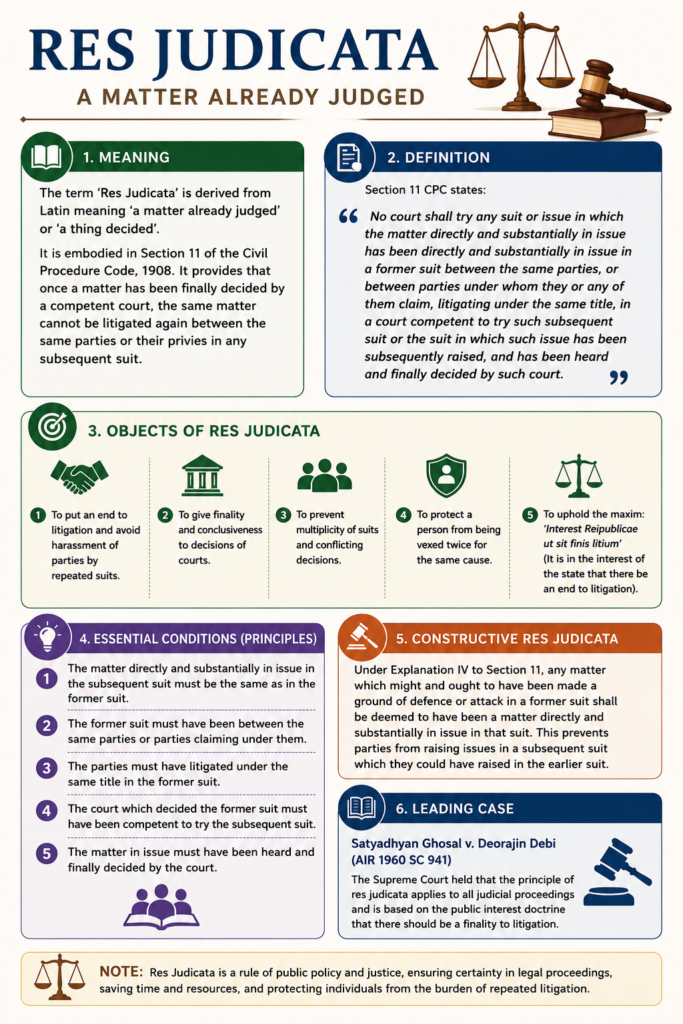
The term ‘Res Judicata’ is derived from Latin meaning ‘a matter already judged’ or ‘a thing decided’. The doctrine is embodied in Section 11 of the Civil Procedure Code, 1908. It provides that once a matter has been finally decided by a competent court, the same matter cannot be litigated again between the same parties or their privies in any subsequent suit.
Definition
Section 11 CPC states: “No court shall try any suit or issue in which the matter directly and substantially in issue has been directly and substantially in issue in a former suit between the same parties, or between parties under whom they or any of them claim, litigating under the same title, in a court competent to try such subsequent suit or the suit in which such issue has been subsequently raised, and has been heard and finally decided by such court.“
Objects of Res Judicata
i. To put an end to litigation and avoid harassment of parties by repeated suits.
ii. To give finality and conclusiveness to decisions of courts.
iii. To prevent multiplicity of suits and conflicting decisions.
iv. To protect a person from being vexed twice for the same cause.
v. To uphold the maxim: ‘Interest Reipublicae ut sit finis litium’ (It is in the interest of the state that there be an end to litigation).
Essential Conditions (Principles)
i. The matter directly and substantially in issue in the subsequent suit must be the same as in the former suit.
ii. The former suit must have been between the same parties or parties claiming under them.
iii. The parties must have litigated under the same title in the former suit.
iv. The court which decided the former suit must have been competent to try the subsequent suit.
v. The matter in issue must have been heard and finally decided by the court.
Constructive Res Judicata
Under Explanation IV to Section 11, any matter which might and ought to have been made a ground of defence or attack in a former suit shall be deemed to have been a matter directly and substantially in issue in that suit. This prevents parties from raising issues in a subsequent suit which they could have raised in the earlier suit.
Leading Case
In Satyadhyan Ghosal v. Deorajin Debi (AIR 1960 SC 941), the Supreme Court held that the principle of res judicata applies to all judicial proceedings and is based on the public interest doctrine that there should be a finality to litigation.
Quick Summary Five Points
- Res Judicata under Section 11 CPC means a matter already decided by a competent court cannot be re-litigated between the same parties.
- The doctrine aims to ensure finality of litigation, prevent multiple suits, and avoid conflicting judicial decisions.
- Essential conditions include same parties, same issue, competent court, same title, and a final decision in the former suit.
- Constructive Res Judicata prevents parties from raising issues later that could and should have been raised in the earlier suit.
- In Satyadhyan Ghosal v. Deorajin Debi, the Supreme Court affirmed that res judicata applies to all judicial proceedings to maintain finality in litigation.