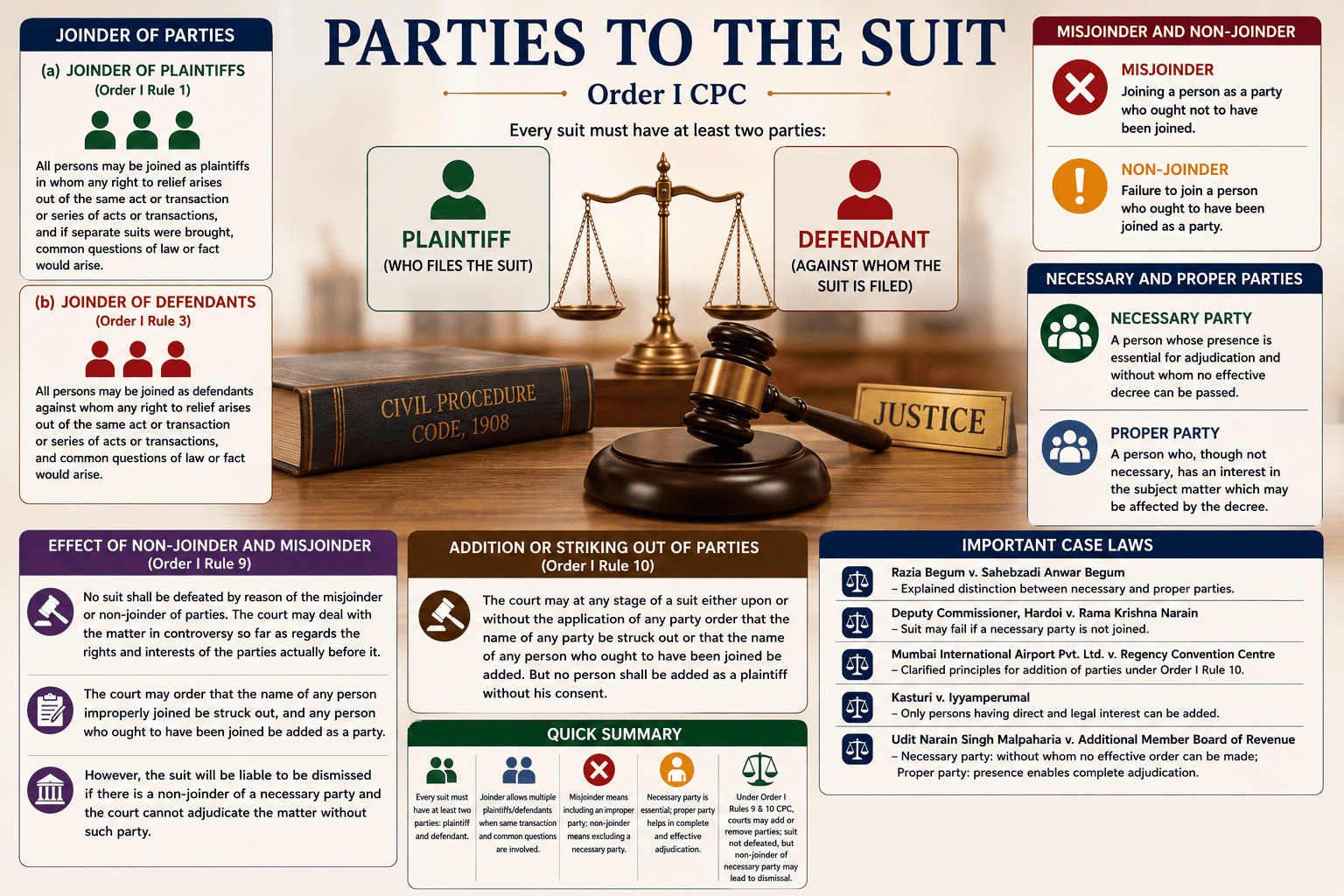
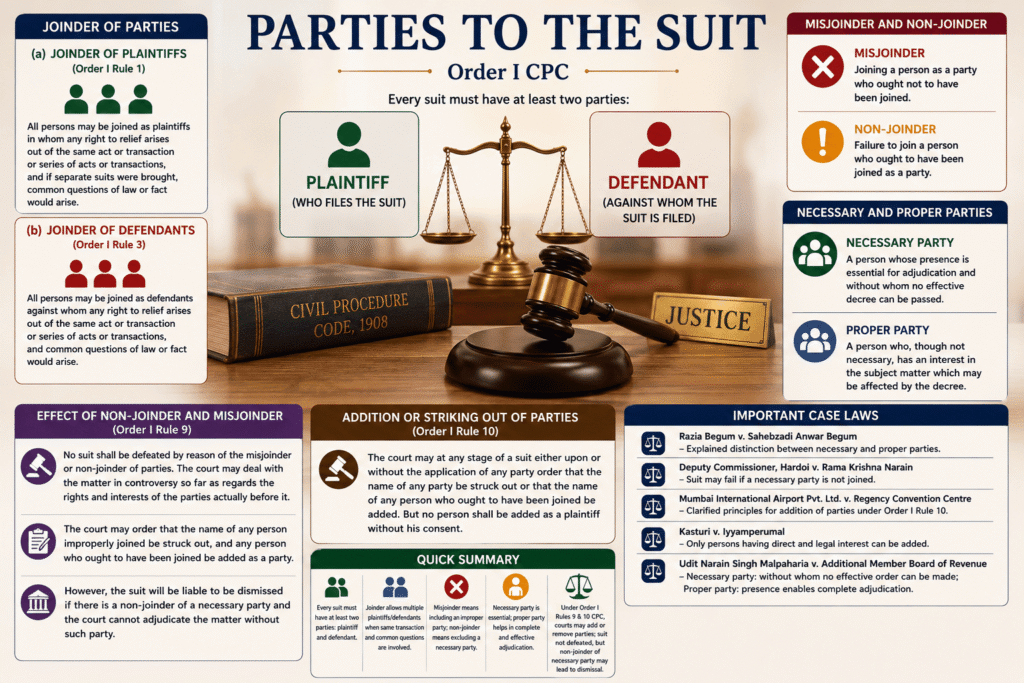
Parties to Suit, are the important parties involved in any suit. as every suit must have at least two parties: the plaintiff (person who files the suit) and the defendant (person against whom the suit is filed). The law relating to parties to a suit is contained in Order I of the CPC.
Joinder of Parties
(a) Joinder of Plaintiffs (Order I Rule 1):
All persons may be joined as plaintiffs in whom any right to relief arises out of the same act or transaction or series of acts or transactions, and if separate suits were brought, common questions of law or fact would arise.
(b) Joinder of Defendants (Order I Rule 3):
All persons may be joined as defendants against whom any right to relief arises out of the same act or transaction or series of acts or transactions, and common questions of law or fact would arise.
Misjoinder and Non-Joinder
Misjoinder: Joining a person as a party who ought not to have been joined.
Non-Joinder: Failure to join a person who ought to have been joined as a party.
Necessary and Proper Parties
Necessary Party: A person whose presence is essential for adjudication and without whom no effective decree can be passed.
Proper Party: A person who, though not necessary, has an interest in the subject matter which may be affected by the decree.
Effect of Non-Joinder and Misjoinder : Order I Rule 9
No suit shall be defeated by reason of the misjoinder or non-joinder of parties. The court may deal with the matter in controversy so far as regards the rights and interests of the parties actually before it. The court may order that the name f any person improperly joined be struck out, and any person who ought to have been joined be added as a party.
However, the suit will be liable to be dismissed if there is a non-joinder of a necessary party and the court cannot adjudicate the matter without such party.
Addition or Striking Out of Parties: Order I Rule 10
The court may at any stage of a suit either upon or without the application of any party order that the name of any party be struck out or that the name of any person who ought to have been joined be added. But no person shall be added as a plaintiff without his consent.
Important case laws relating to Parties to Suit, Joinder, Misjoinder, and Non-Joinder under Order I CPC:
- Razia Begum v. Sahebzadi Anwar Begum
The Supreme Court explained the distinction between necessary parties and proper parties. It held that a person may be added as a party if they have a direct interest in the subject matter of the suit. - Deputy Commissioner, Hardoi v. Rama Krishna Narain
The Court held that a suit may fail if a necessary party is not joined because no effective decree can be passed in their absence. - Mumbai International Airport Pvt. Ltd. v. Regency Convention Centre
The Supreme Court clarified the principles governing addition of parties under Order I Rule 10 CPC and explained when a party can be considered necessary or proper. - Kasturi v. Iyyamperumal
The Supreme Court held that only persons having a direct and legal interest in the subject matter can be added as parties to the suit. - Udit Narain Singh Malpaharia v. Additional Member Board of Revenue
The Court observed that a necessary party is one without whom no effective order can be made, while a proper party is one whose presence enables complete adjudication.
Quick Summary
- Every suit under the CPC must have at least two parties, the plaintiff and the defendant, governed by Order I CPC.
- Joinder of parties allows multiple plaintiffs or defendants to be included in one suit when the dispute arises from the same transaction and involves common questions of law or fact.
- Misjoinder means including an improper party, while non-joinder means excluding a person who should have been made a party.
- A necessary party is essential for passing an effective decree, whereas a proper party is one whose presence helps complete adjudication of the dispute.
- Under Order I Rules 9 and 10 CPC, suits are generally not defeated due to misjoinder or non-joinder, but failure to include a necessary party may result in dismissal; courts may also add or remove parties at any stage of the suit.