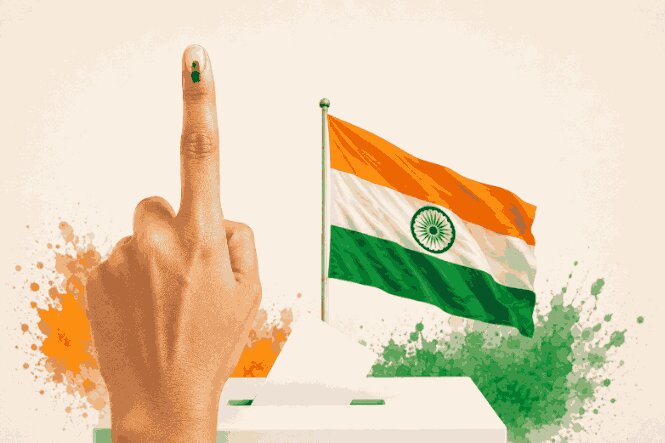
“The greatest lie we’ve been told is that casting a vote is the ultimate duty of a citizen in a democracy.”
Introduction: Voting Is Not Democracy
Abraham Lincoln famously defined democracy as “government of the people, by the people, for the people.” Yet somewhere between that democratic ideal and our present reality, the meaning of democracy has been quietly hollowed out and reduced to a single act: voting.
We are repeatedly told that democracy lives and dies in the ballot box. That is, at best, a half-truth. At worst, it is a convenient lie told to a population conditioned to go quiet for five years at a time.
Voting is not democracy; it is only the beginning of democratic participation.
The concept of voting is not new. Neither is democracy. But in recent times, the behaviour of governments, particularly the BJP-led government in India under Prime Minister Narendra Modi, has, in my view, reflected a troubling pattern visible across many democracies: political parties present themselves as the ultimate voice of the people while gradually drifting away from accountability to those very people.
India is not alone in facing this problem. The pattern can be observed in democracies across the world.
So, the question must be asked: Why does democracy feel so alien to the ordinary citizen when it is supposed to belong to them? Why does an elected government so often feel more like an opponent than a representative? Why does an elected body, once in power, sometimes begin to behave in ways that appear absurd or disconnected from the lives of ordinary people?
“People forget and that forgetting is the greatest gift they give to those in power.”
The Duty That Doesn’t End at the Voting Booth
The answers are simpler than they appear, but also more troubling.
Citizens vote, then vanish. Leaders win, then assume licence.
The moment the ballot is cast, many people believe that their democratic duty has been fulfilled, until the next election cycle arrives. Political leaders, knowing this, may calibrate their performance accordingly.
Governance then risks becoming theatre: ribbon-cutting ceremonies, inaugurations of half-finished projects, carefully managed public appearances, political speeches, and media campaigns timed according to electoral calendars.
The people of India and citizens of every democracy must hold firmly to one truth: the duty to choose a government does not end with the act of voting.
Democracy runs on the continued will and participation of its people. That democratic will must not be surrendered at the exit of a polling station.
The moment citizens disengage from public affairs, their democratic power is quietly inherited by those already in authority. And power without sufficient public scrutiny creates the conditions for arbitrariness, abuse, and corruption.
That is why voting is not democracy in itself. Voting gives representatives authority, but active citizenship is what keeps that authority accountable.
Democracy Means the Duty to Question and Confront
Democracy should never be understood merely as a procedural right, the right to vote based on universal adult franchise.
It is equally, and perhaps more importantly, the right and democratic duty to question, confront, criticise, and demand accountability.
Citizens must question their MLA and MP. They must seek answers from their municipal representatives and public authorities. They must demand accountability from those exercising public power not merely on election day, but throughout their term in office.
And yet, many citizens focus only on the visible faces: the political leaders who appear in newspapers, television debates, rallies, advertisements, and social media feeds.
True democratic awareness requires something sharper, the ability to see through political performance and understand the structures of power operating behind it.
The forces shaping public policy are not always the ones standing on the political stage. Powerful financial interests, political brokers, influential organisations, sections of the media, ideological groups, and elite networks may exercise considerable influence over political decisions.
These influences deserve democratic scrutiny too.
“The fight for democracy does not end with independence from outside powers. It begins with holding accountable the people we ourselves chose.”
The Old Kings and the New Kingmakers
In older times, the king was both the visible face and the actual centre of political authority. Power and face were one.
In modern democracies, however, political power can be far more complicated.
The visible political leader may hold constitutional office, but governments and political parties also operate within wider networks of money, media, ideology, lobbying, party organisation, and social influence.
Party financiers, influential media owners, ideological gatekeepers, political strategists, lobby groups, and circles of elite interest can sometimes become powerful kingmakers.
This creates a serious democratic question because, unlike elected representatives, many such actors are not directly accountable to voters.
A democratic citizen, therefore, needs what may metaphorically be called “X-ray vision” i.e., the ability to look beyond the public face and examine the structures of influence behind political power.
We must ask:
Who does this leader actually serve?
Whose interests are advanced when a particular policy is introduced?
Who financially or politically benefits from a government decision?
Who benefits from the government’s silence?
Who influences the political narrative presented to the public?
These are the questions that matter in a functioning democracy. And they can only be asked by citizens who refuse to fall asleep after casting their votes.
What Your Vote Actually Means in a Democracy
Your vote is not simply a stamp on a political symbol, a face, or a name you recognise.
A vote can be understood as a democratic contract, a conditional transfer of political authority based on promises, policies, leadership, and a particular vision of governance.
You do not elect a ruler. You elect a representative.
That distinction is fundamental.
When representatives fail to fulfil their promises, misuse authority, ignore public concerns, or act against the interests of the people, citizens have every democratic right to question them.
They also have a responsibility to do so — peacefully, constitutionally, persistently, and without apology.
The right to vote therefore cannot be separated from the broader rights that make democracy meaningful: freedom of speech and expression, peaceful assembly, association, access to information, criticism of government, public participation, and the ability to demand accountability from public authorities.
Democracy Beyond Elections
There are many constitutional and democratic ways through which citizens can make their voices heard beyond the ballot box.
Citizens can participate in peaceful public assemblies, organise civic petitions, use lawful democratic protest, build community organisations, demand transparency from local authorities, seek information about public expenditure, approach appropriate institutions, participate in public discussions, communicate with elected representatives, and use digital and social media as tools for civic engagement rather than merely entertainment.
The democratic tools exist.
What is often missing is the belief among ordinary citizens that using them actually matters.
A citizen should not disappear from public life after voting and suddenly reappear five years later.
Between two elections lie thousands of government decisions, policies, budgets, laws, administrative actions, and exercises of public power. That period between elections is where much of democracy actually happens.
Voting Is a Right, but Accountability Keeps Democracy Alive
Elections are indispensable to representative democracy. Without free and fair elections, citizens cannot peacefully choose or replace governments.
But elections alone cannot guarantee democratic governance.
A country may conduct elections regularly and still experience declining accountability, weakened institutions, concentration of political power, reduced transparency, or an increasingly passive citizenry.
Therefore, the health of democracy cannot be measured only by asking:
“Did people vote?”
We must also ask:
“Were citizens able to question those they elected?”
“Were elected representatives accountable?”
“Could people criticise the government without fear?”
“Were public institutions functioning independently?”
“Did citizens continue participating after the election ended?”
These questions reveal the difference between simply conducting elections and actually sustaining a democratic culture.
Conclusion: Voting Is the Beginning, Not the End
So, the next time someone tells you that voting is the prime duty or the defining act of democracy, remember that the truth is much larger.
Voting is essential. Voting matters. Voting gives citizens the power to choose who will exercise public authority.
But voting is not democracy by itself.
The ballot is where democratic responsibility begins, not where it ends.
Democracy is questioning your representatives. Democracy is demanding transparency. Democracy is peaceful resistance when power becomes arbitrary. Democracy is holding public authorities accountable. Democracy is defending the rights of others as well as your own. Democracy is remaining politically and socially conscious even when no election is approaching.
Above all, democracy requires citizens who understand that elected representatives are public servants, not kings.
Democracy is not an event. It is a permanent, ongoing, and sometimes uncomfortable act of participation.
It does not sleep between elections.
And neither should we.
— Deepak Sirsat
@deepak_3.14th