
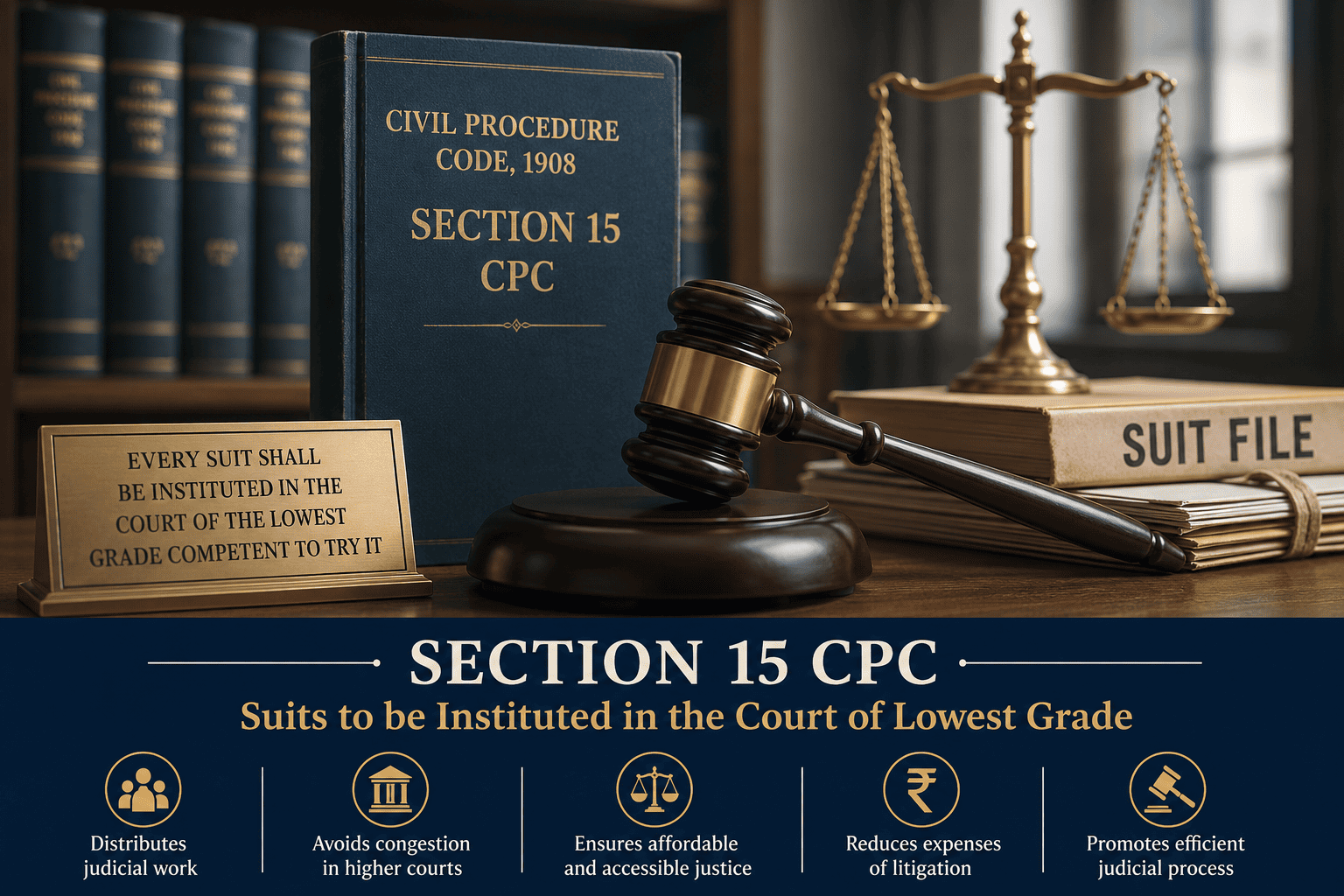
Every suit shall be instituted in the Court of the lowest
grade competent to try it
Section 15 Civil Procedure Code
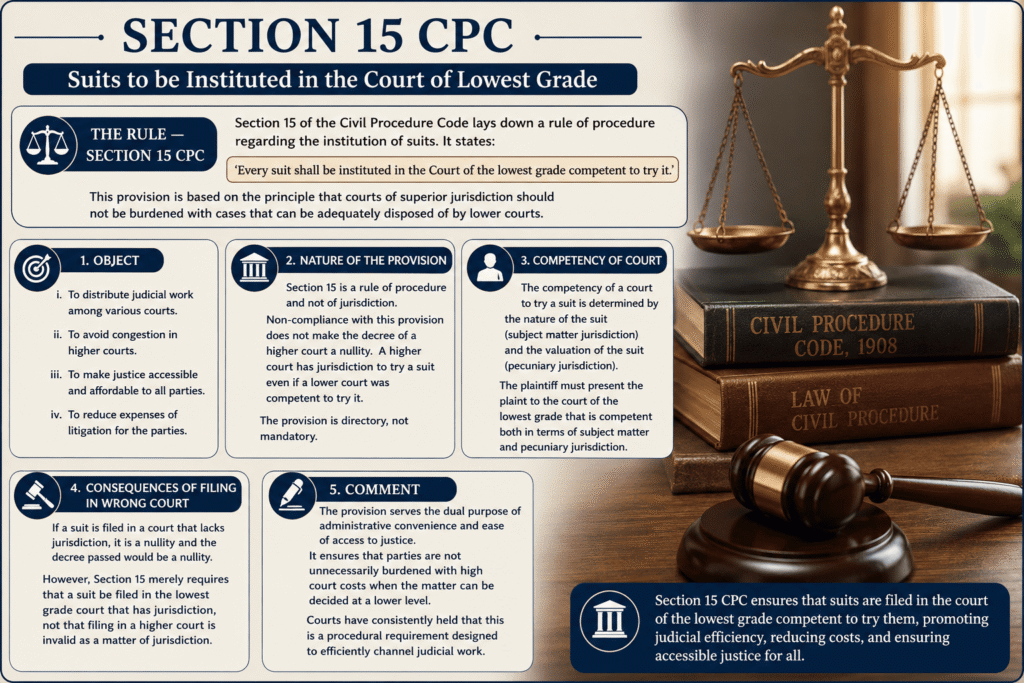
Section 15 of the Civil Procedure Code lays down a rule of procedure regarding the institution of suits. It states: ‘Every suit shall be instituted in the Court of the lowest grade competent to try it.’ This provision is based on the principle that courts of superior jurisdiction should not be burdened with cases that can be adequately disposed of by lower courts.
Object
i. To distribute judicial work among various courts.
ii. To avoid congestion in higher courts.S
iii. To make justice accessible and affordable to all parties.
iv. To reduce expenses of litigation for the parties.
Nature of the Provision
Section 15 is a rule of procedure and not of jurisdiction. Non-compliance with this provision does not make the decree of a higher court a nullity. A higher court has jurisdiction to try a suit even if a lower court was competent to try it. The provision is directory, not mandatory.
Competency of Court
The competency of a court to try a suit is determined by the nature of the suit (subject matter jurisdiction) and the valuation of the suit (pecuniary jurisdiction). The plaintiff must present the plaint to the court of the lowest grade that is competent both in terms of subject matter and pecuniary jurisdiction.
Consequences of Filing in Wrong Court
If a suit is filed in a court that lacks jurisdiction, it is a nullity and the decree passed would be a nullity. However, Section 15 merely requires that a suit be filed in the lowest grade court that has jurisdiction, not that filing in a higher court is invalid as a matter of jurisdiction.
Comment
The provision serves the dual purpose of administrative convenience and ease of access to justice. It ensures that parties are not unnecessarily burdened with high court costs when the matter can be decided at a lower level. Courts have consistently held that this is a procedural requirement designed to efficiently channel judicial work.
Quick Summary
- Section 15 CPC provides that every suit should be filed in the court of the lowest grade competent to try it.
- The provision aims to distribute judicial work efficiently, reduce burden on higher courts, and make litigation more affordable.
- Section 15 is procedural in nature, not a rule of jurisdiction; therefore, a decree passed by a higher competent court is not invalid merely because a lower court could have tried the suit.
- Court competency depends on subject matter jurisdiction and pecuniary jurisdiction, requiring plaintiffs to file suits in the appropriate lower court.
- The rule promotes administrative convenience, reduces litigation expenses, and ensures easier access to justice while preventing unnecessary congestion in superior courts.