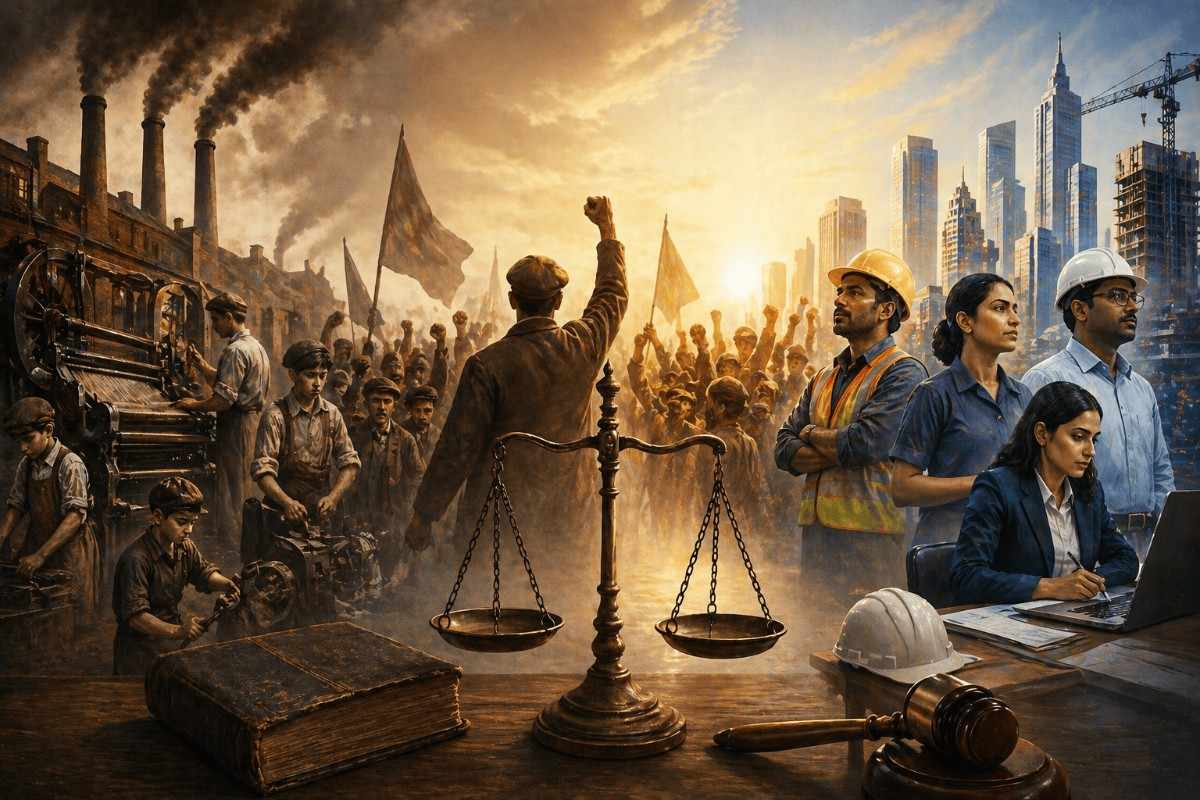
Labour law has evolved as a response to changing economic conditions and the continuous struggle for workers’ rights. What began as minimal or no protection for labourers gradually transformed into a system aimed at ensuring dignity, fairness, and social justice. Understanding this evolution helps in appreciating how modern labour laws seek to balance the interests of employers and employees while promoting humane working conditions.
Introduction
Labour law is one of the most dynamic and socially significant branches of law. It governs the relationship between employers and employees and aims to ensure fairness, dignity, and protection for workers. The development of labour laws is closely connected with the growth of industrial society, economic changes, and the struggle for human rights.
Unlike many other areas of law that evolved through judicial interpretation alone, labour law is deeply rooted in social movements, economic pressures, and political ideologies. Its journey reflects a transformation from a system that allowed unrestricted exploitation of workers to one that seeks to establish balance, equity, and social justice.
History and Evolution of Labour Laws
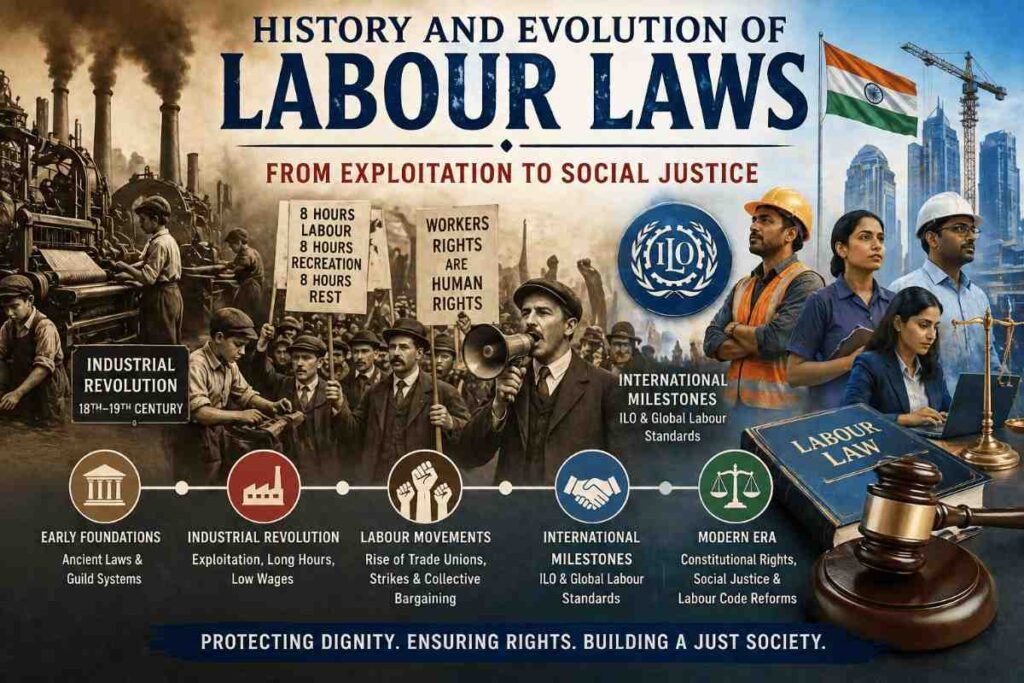
Early Foundations of Labour Regulation
The idea of regulating labour is not new. Even ancient civilizations recognised the importance of controlling employer-employee relationships.
One of the earliest examples can be found in the Code of Hammurabi (18th century BCE), which contained provisions relating to wages, contracts, and responsibilities of workers. Similarly, in ancient India, texts like the Manusmriti laid down rules regarding duties of servants and masters. However, these systems were largely based on status and hierarchy, rather than equality.
During the medieval period in Europe, the guild system played a significant role. Guilds were associations of artisans and craftsmen that regulated trade practices, working conditions, wages, and training through apprenticeship. While not labour laws in the modern sense, guilds represented an early form of collective regulation and worker protection.
Impact of the Industrial Revolution
The real transformation in labour law began with the Industrial Revolution in the 18th and 19th centuries. This period marked a shift from agrarian economies to industrial production, leading to the rise of factories and mass employment.
However, this economic progress came at a significant human cost. Workers were subjected to extremely harsh conditions. Working hours often extended to 14–16 hours a day, wages were minimal, and there were no safety measures in factories. Women and children were employed in dangerous environments, and there was no concept of job security or social protection.
At this stage, the prevailing legal philosophy was laissez-faire, which meant that the State should not interfere in private contracts. Employers had complete freedom, while workers, due to poverty and lack of alternatives, had little bargaining power. This resulted in what can be described as “freedom of contract in theory but coercion in practice.”
The widespread exploitation led to protests, strikes, and the rise of labour movements. Gradually, governments realised that non-intervention was no longer sustainable, and this marked the beginning of modern labour legislation.
Influence of Political and Social Movements
The evolution of labour laws was also influenced by major political events, particularly the French Revolution of 1789. The principles of liberty, equality, and fraternity challenged existing social hierarchies and emphasised the importance of human dignity.
These ideas contributed to the recognition that workers are not merely factors of production but human beings entitled to rights and respect. Over time, this led to the development of laws focusing on:
- Limiting working hours
- Ensuring minimum wages
- Protecting women and children
- Recognising the right to organise and protest
Rise of Trade Unions and Collective Bargaining
As industrialisation progressed, workers began to organise themselves into groups to protect their interests. This led to the emergence of trade unions, which played a crucial role in shaping labour laws.
Trade unions introduced the concept of collective bargaining, shifting the focus from individual employment contracts to group negotiations. This significantly improved the bargaining power of workers and forced employers and governments to recognise labour rights.
The right to strike, though controversial, became an important tool for workers to express grievances and demand better conditions.
Internationalisation of Labour Law
The early 20th century witnessed the global recognition of labour rights. A major milestone was the establishment of the International Labour Organization (ILO) in 1919 after World War I.
The ILO aimed to promote social justice and improve labour conditions worldwide. It introduced international standards on issues such as:
- Freedom of association
- Abolition of forced labour
- Elimination of child labour
- Non-discrimination in employment
Labour law thus evolved from a national concern into an international human rights issue, influencing legislation across countries, including India.
History of Labour Laws in India (Pre-Independence Era)
The development of labour laws in India began during British rule, but their primary objective was not worker welfare. Instead, they were designed to serve colonial economic interests.
British industries, especially textiles, faced competition from Indian products. To reduce this competition, the British government introduced laws that increased the cost of production in India under the guise of labour welfare.
One of the earliest laws was the Factories Act of 1881, which was later amended several times. It introduced limited regulations on working hours and conditions, particularly for children. Although it appeared progressive, its underlying purpose was economic rather than humanitarian.
With the growth of industries, workers in India began facing severe exploitation, which led to the emergence of labour movements and trade unions.
Developments After World War I
After World War I, labour issues gained international importance, and India, being part of the global system, also introduced reforms.
The Trade Unions Act, 1926 gave legal recognition to trade unions and protected their activities. This was a significant step in empowering workers.
The Trade Disputes Act, 1929 introduced mechanisms for resolving industrial disputes and regulating strikes and lockouts.
Around the same time, the Royal Commission on Labour (1929) was established to study labour conditions in India. Although it faced opposition from Indian leaders, its report highlighted poor working conditions and recommended several reforms.
Late Colonial Labour Legislations
Based on growing pressure and recommendations, several important laws were enacted:
- The Payment of Wages Act, 1936 ensured timely payment of wages and prevented arbitrary deductions.
- The Industrial Employment (Standing Orders) Act, 1946 required employers to clearly define conditions of employment.
- The Industrial Disputes Act, 1947 (enacted just before independence) provided a comprehensive framework for resolving industrial disputes.
These laws laid the foundation for the labour law system in independent India.
Labour Laws in Independent India
After independence, India adopted a welfare state model, and labour laws were restructured to promote social and economic justice.
Constitutional Framework
The Constitution of India plays a central role in shaping labour laws. It guarantees fundamental rights such as equality, freedom of association, and protection against forced labour.
The Directive Principles of State Policy further emphasise the need for:
- Just and humane working conditions
- Living wages
- Social security
- Equal pay for equal work
These provisions reflect the commitment of the State to protect the dignity of labour.
Post-Independence Labour Legislations
Independent India enacted several laws to improve labour welfare, including:
- The Factories Act, 1948, which ensures health, safety, and welfare of workers
- The Minimum Wages Act, 1948, which guarantees fair wages
- The Employees’ State Insurance Act, 1948, which provides medical benefits
- The Employees’ Provident Funds Act, 1952, which ensures financial security
These laws marked a shift from mere regulation to comprehensive welfare and social security.
Role of Judiciary in Labour Law
The Indian judiciary has played a transformative role in labour law. Courts have interpreted constitutional provisions to expand workers’ rights, particularly under the right to life and dignity.
Judicial decisions have addressed issues such as bonded labour, child labour, and unfair labour practices, ensuring that labour laws are not only theoretical but also effectively implemented.
Recent Labour Law Reforms in India
In recent years, India has undertaken major labour law reforms by consolidating numerous laws into four Labour Codes:
- Code on Wages, 2019
- Industrial Relations Code, 2020
- Social Security Code, 2020
- Occupational Safety, Health and Working Conditions Code, 2020
These reforms aim to simplify compliance, improve ease of doing business, and extend protection to workers in both organised and unorganised sectors.
Conclusion
The history and evolution of labour laws represent a continuous struggle to achieve justice, dignity, and fairness in the workplace. From ancient moral codes to modern constitutional frameworks, labour law has evolved in response to changing social and economic realities.
Labour Laws in India, this journey reflects a transition from colonial exploitation to a rights-based and welfare-oriented system. Today, labour laws not only regulate employment but also serve as a tool for promoting human dignity, equality, and social justice in a rapidly changing world.
Quick Summary
- Labour laws evolved from ancient systems like the Code of Hammurabi and guild practices, initially based on hierarchy rather than equality.
- The Industrial Revolution exposed severe worker exploitation, leading to the need for State intervention and modern labour legislation.
- Social and political movements, along with trade unions, strengthened workers’ rights through collective bargaining and labour protections.
- International efforts, especially the establishment of the ILO, globalised labour rights as part of human rights.
- In India, labour laws evolved from colonial economic tools to a welfare-oriented system supported by the Constitution and recent labour code reforms.