1. Introduction
Law plays a fundamental role in organizing and regulating human society. Every society develops a system of rules to maintain order, resolve disputes, and protect rights. However, legal systems are complex and deal with many different types of relationships and situations. To make the legal system more organized and effective, jurists classify law into different categories. Hence today we are seeing Types of Law.
The classification of law helps in understanding how legal rules operate in different contexts. Some laws govern the relationship between individuals and the state, while others regulate relationships between private individuals. Similarly, certain laws focus on punishing harmful conduct, while others deal with resolving disputes and providing remedies.
Understanding the types of law is therefore essential for law students, legal professionals, and ordinary citizens. It helps clarify how different legal rules function and how disputes are addressed within the legal system.
In jurisprudence, one of the most common classifications divides law into public law and private law, as well as civil law and criminal law. Each category serves a different purpose and plays a distinct role in maintaining social order.
2. Classification of Law
Before examining the types of law, it is important to briefly understand what law means.
Law may be defined as a system of rules recognized and enforced by the state to regulate human behavior and maintain social order. These rules determine rights, duties, and responsibilities of individuals within society.
Various jurists have defined law in different ways. For example:
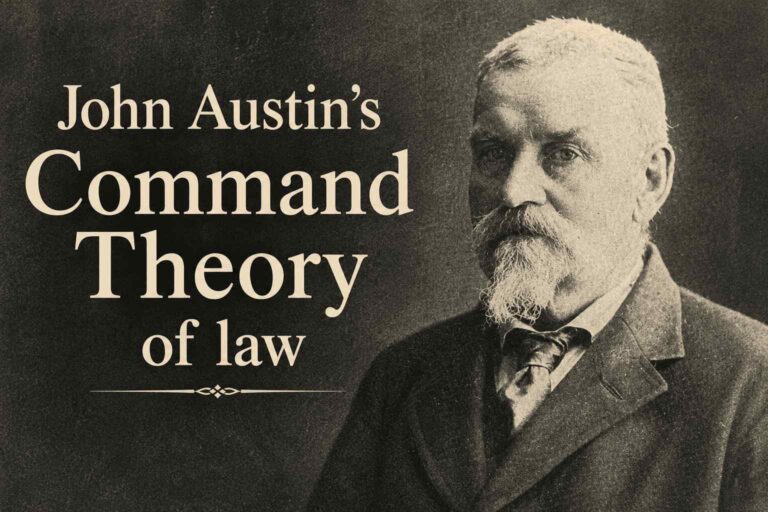
a) John Austin described law as the command of the sovereign backed by sanctions.
b) Salmond defined law as the body of principles recognized and applied by the state in the administration of justice.
c) Roscoe Pound viewed law as a tool of social engineering designed to balance competing interests in society.
Because legal systems regulate numerous social activities, jurists classify laws into different categories. This classification helps in:
- organizing legal rules
- improving the administration of justice
- simplifying legal understanding
- enabling specialization within the legal profession
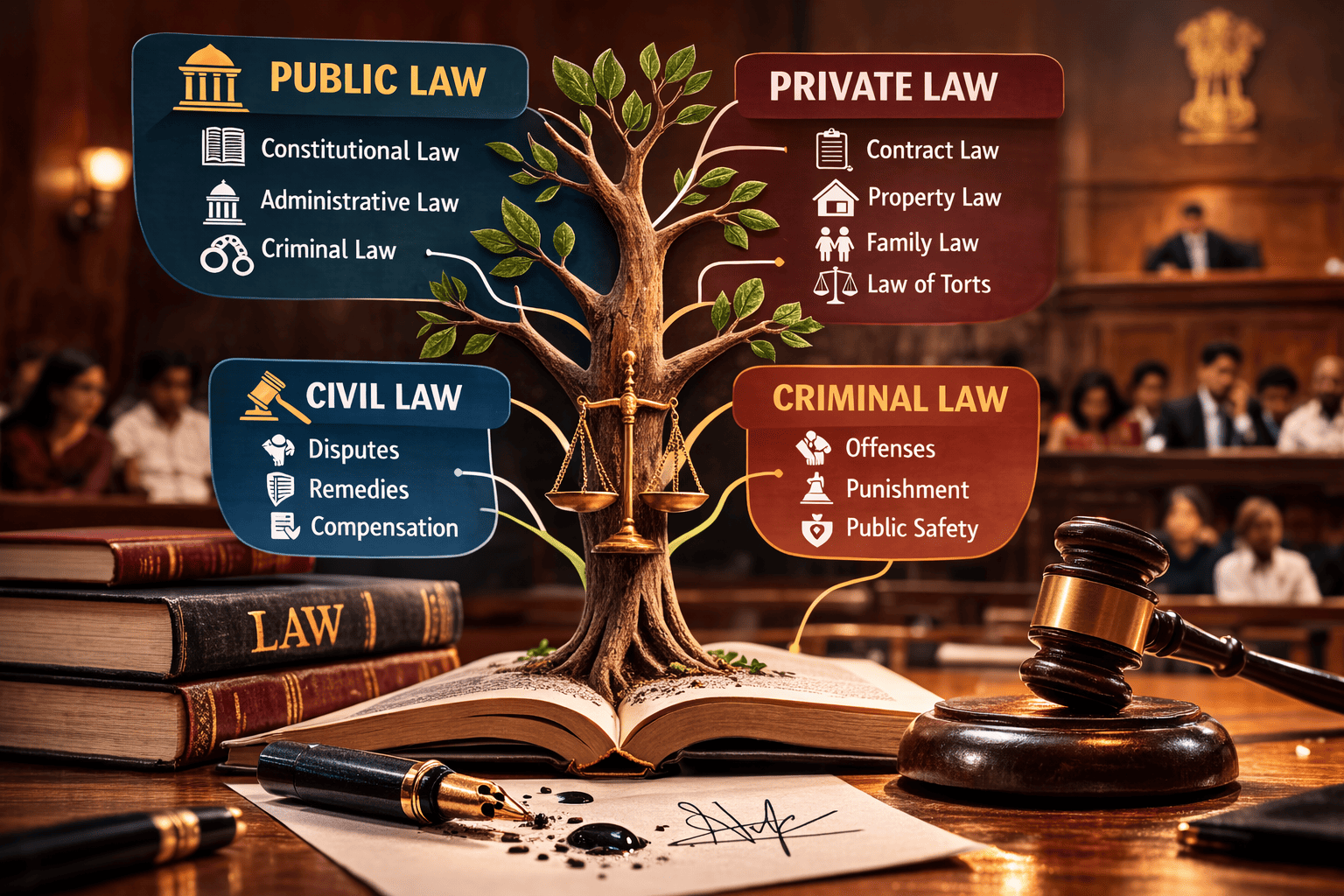
One of the most important classifications divides law into public law and private law, while another distinguishes civil law from criminal law.
3. Public Law and Private Law
One of the fundamental divisions in jurisprudence is between public law and private law.
A] Public Law
Public law governs the relationship between individuals and the state. It regulates the exercise of governmental authority and ensures that state institutions function within constitutional limits.
Public law is primarily concerned with public interest and the organization of government power.
Examples of public law include:
a) Constitutional Law:
Constitutional law deals with the structure of government and the protection of fundamental rights. It defines the powers and responsibilities of various branches of government.
b) Administrative Law:
Administrative law regulates the actions of government agencies and public officials. It ensures that administrative decisions are lawful, reasonable, and fair.
c) Criminal Law:
Criminal law deals with offenses against society and is enforced by the state through prosecution and punishment.
Public law therefore plays a crucial role in maintaining constitutional governance and protecting the public interest.
B] Private Law
Private law governs relationships between individuals or private entities. It focuses on protecting personal rights and resolving disputes between private parties.
Unlike public law, private law does not directly involve the state as a party to the dispute (except as a neutral adjudicator).
Examples of private law include:
a) Contract Law:
Contract law governs agreements between individuals or businesses and provides remedies when agreements are breached.
b) Property Law:
Property law regulates ownership, transfer, and use of property.
c) Family Law:
Family law deals with legal relationships within families, including marriage, divorce, adoption, and inheritance.
d) Law of Torts:
The law of torts deals with civil wrongs that cause harm to individuals, such as negligence or defamation.
Private law therefore helps maintain order in personal, social, and commercial relationships.
4. Civil Law
Civil law refers to the body of law that deals with disputes between individuals or organizations involving legal rights and obligations.
Civil cases typically involve situations where one party claims that another party has violated their legal rights.
Characteristics of Civil Law
Civil law has several important features:
- It deals primarily with private disputes.
- The case is usually initiated by the aggrieved party.
- The main objective is to provide remedies or compensation rather than punishment.
Examples of Civil Cases
Examples of civil disputes include:
- breach of contract
- property disputes
- family law matters such as divorce
- claims for damages due to negligence
Civil courts resolve such disputes by awarding remedies such as compensation, injunctions, or declarations of rights.
5. Criminal Law
Criminal law deals with offenses that are considered harmful to society as a whole. These offenses are treated as crimes against the state.
Unlike civil cases, criminal cases are prosecuted by the state or government authorities.
Characteristics of Criminal Law
Key features of criminal law include:
- Acts that threaten public safety and social order.
- Prosecution initiated by the state.
- Punishment imposed on offenders.
Examples of Criminal Offenses
Common criminal offenses include:
- murder
- theft
- fraud
- assault
In India, criminal law is largely governed by important statutes such as:
- Bharatiya Nyay Sanhita 2023 (Penal Code statute)
- Bharatiya Nagarik Surksha Sanhita 2023 (Procedural Code)
Criminal law plays a crucial role in maintaining public order, safety, and social stability.
6. Difference Between Civil Law and Criminal Law
Although both branches of law deal with legal disputes, they differ significantly in their purpose and procedures.
| Basis | Civil Law | Criminal Law |
| Nature | Private disputes | Offenses against society |
| Parties | Individual vs individual | State vs accused |
| Objective | Compensation or remedy | Punishment |
| Burden of Proof | Balance of probabilities | Beyond reasonable doubt |
Explanation
In civil law, the goal is usually to compensate the injured party for the harm suffered. For example, a person who breaches a contract may be required to pay damages.
In criminal law, the objective is to punish wrongdoing and deter criminal behavior. For example, a person convicted of theft may face imprisonment or fines.
Another important difference lies in the standard of proof. Criminal cases require proof beyond reasonable doubt, whereas civil cases require proof based on the balance of probabilities.
7. Importance of Classification of Law
The classification of law into different categories is essential for the effective functioning of legal systems.
First, it helps courts administer justice more efficiently by applying appropriate procedures for different types of cases.
Second, it clarifies legal processes and makes it easier for individuals to understand their legal rights and responsibilities.
Third, classification allows lawyers to specialize in different fields of law such as criminal law, civil law, or constitutional law.
Finally, it helps citizens better understand how the legal system operates and how their disputes can be resolved.
8. Types of Law in the Indian Legal System
The Indian legal system incorporates multiple branches of law to regulate different aspects of society.
a) Constitutional Law:
Constitutional law governs the structure of government and protects fundamental rights under the Constitution of India.
b) Criminal Law:
Criminal law deals with offenses against society and is primarily governed by the Indian Penal Code and Code of Criminal Procedure.
c) Civil Law:
Civil law governs private disputes and includes areas such as contract law, property law, tort law, and family law.
d) Personal Laws:
India also recognizes various personal laws governing marriage, inheritance, and family relations among different religious communities.
Together, these branches of law form a comprehensive legal system that regulates social relations and ensures justice.
9. Conclusion
The classification of law into civil law, criminal law, public law, and private law plays a vital role in organizing legal systems and ensuring effective administration of justice.
Each category serves a specific purpose. Public law regulates the relationship between individuals and the state, while private law governs relationships among individuals. Civil law focuses on resolving disputes and providing remedies, whereas criminal law seeks to punish acts that harm society.
Understanding the types of law helps law students, legal professionals, and citizens better comprehend how legal systems function and how different legal rules apply in various situations.
Ultimately, the classification of law ensures that legal systems remain structured, efficient, and capable of addressing the diverse needs of society.
To understand the Juriprudential Debate on law and Morality? What is law and how it’s works? Click Here, to understand Rule of Law
Quick Revision Summary
- Law is classified into different categories to organize legal rules and improve the administration of justice.
- Public law governs relationships between individuals and the state, while private law regulates relations among individuals.
- Civil law deals with private disputes and provides remedies such as compensation.
- Criminal law addresses offenses against society and imposes punishments.
- Understanding the types of law helps individuals understand how legal systems regulate social relationships.
References
- JOHN SALMOND, SALMOND ON JURISPRUDENCE (P.J. Fitzgerald ed., 12th ed., Universal Law Publishing).
- H.L.A. HART, THE CONCEPT OF LAW (3d ed., Oxford University Press).
- ROSCOE POUND, AN INTRODUCTION TO THE PHILOSOPHY OF LAW (Yale University Press).
- V.D. MAHAJAN, JURISPRUDENCE AND LEGAL THEORY (Eastern Book Company).
- N.V. PARANJAPE, STUDIES IN JURISPRUDENCE AND LEGAL THEORY (Central Law Agency).
- G.W. PATON, A TEXTBOOK OF JURISPRUDENCE (Oxford University Press).
- R.W.M. DIAS, JURISPRUDENCE (Butterworths).