
1. Introduction
During the nineteenth century, legal scholars began to examine law in a more systematic and analytical way. Instead of focusing primarily on moral philosophy or religious doctrines, they attempted to study law as a structured system of rules created and enforced by political authority. This intellectual movement gave rise to what is known as analytical jurisprudence.
One of the most influential figures in this development was John Austin, an English jurist whose work significantly shaped modern legal philosophy. Austin attempted to explain the nature of law through a logical and scientific approach. His theory, commonly known as the Command Theory of Law, became one of the earliest systematic attempts to define law in terms of authority, obedience, and sanctions.
Austin argued that law is essentially a command issued by a sovereign authority and backed by sanctions for disobedience. According to him, the validity of law does not depend on moral considerations but on its source—namely, the authority that creates and enforces it.
Although later scholars criticized and refined his ideas, Austin’s theory remains a foundational concept in the study of legal positivism and analytical jurisprudence. Understanding the command theory of law helps law students grasp the relationship between legal authority, obedience, and enforcement in modern legal systems.
2. John Austin and Analytical Jurisprudence
John Austin (1790–1859) was a British legal philosopher who played a major role in developing analytical jurisprudence, also known as legal positivism. Analytical jurisprudence focuses on the logical analysis of legal concepts such as law, duty, rights, sovereignty, and sanctions.
Austin’s most influential work, “The Province of Jurisprudence Determined” (1832), attempted to establish jurisprudence as a scientific discipline by examining the nature and structure of law.
Austin believed that earlier legal theories, particularly natural law theories, relied too heavily on moral or theological arguments. Instead, he proposed that law should be studied objectively and independently of moral judgments.
For Austin, the primary task of jurisprudence was to analyze positive law, which refers to law created by political authorities and enforced by the state.
This approach marked an important shift in legal philosophy because it emphasized law as it exists in practice rather than law as it ought to be.
3. Meaning of Command Theory of Law
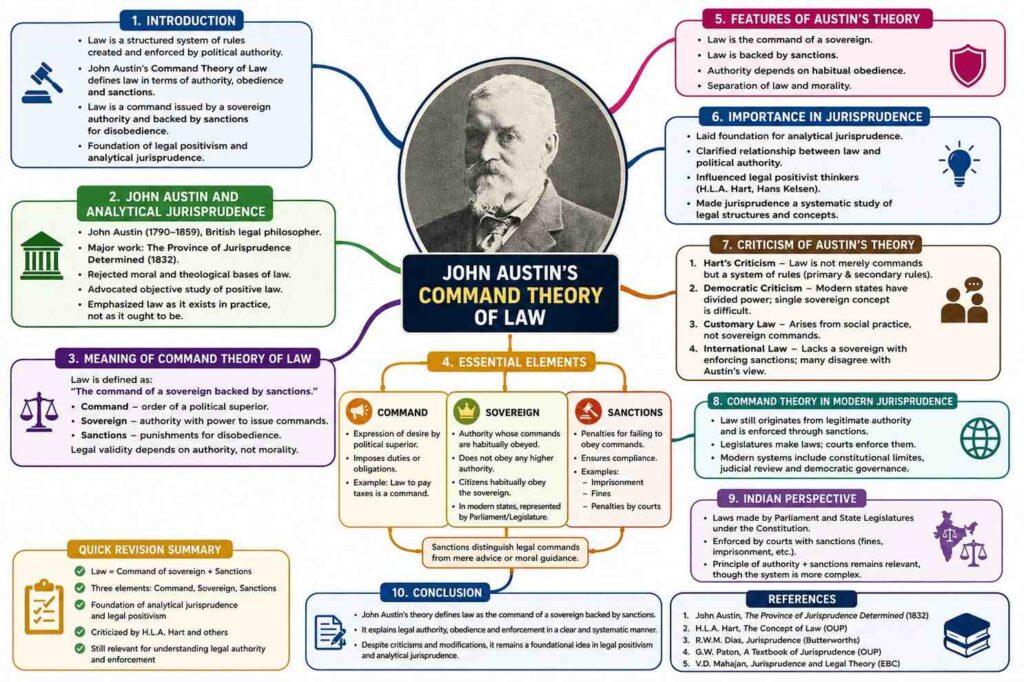
The Command Theory of Law is the central idea in John Austin’s legal philosophy. According to this theory, law can be defined as:
“The command of a sovereign backed by sanctions.”
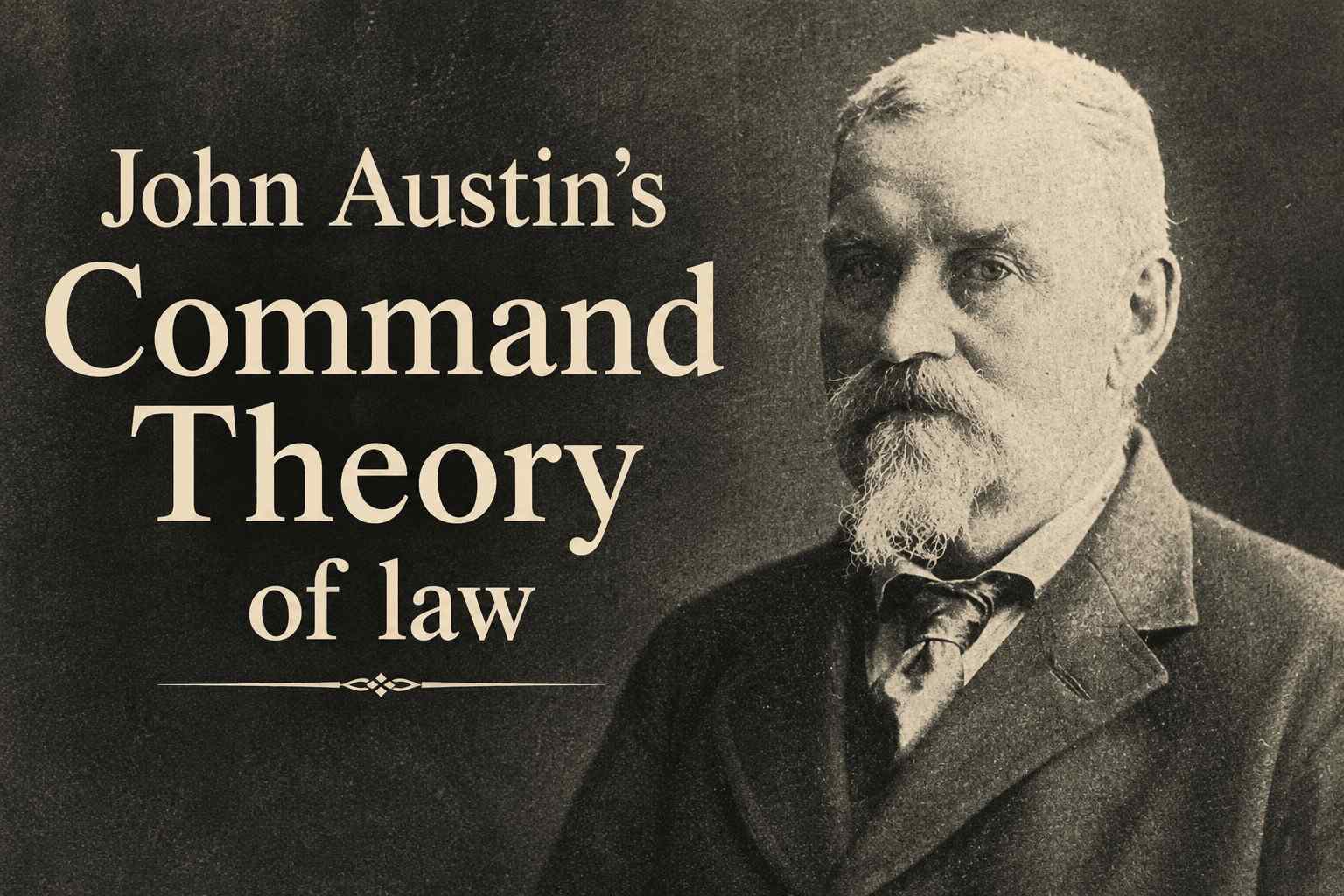
John Austin
In this definition:
- Command refers to an order issued by a political superior.
- Sovereign refers to the authority that has the power to issue commands.
- Sanctions refer to punishments imposed for disobedience.
Austin argued that laws are binding because they are issued by a sovereign authority and enforced through penalties or sanctions.
For example, a law prohibiting theft is valid not necessarily because it is morally correct, but because it is enacted by a recognized authority and backed by punishment if violated.
Thus, the command theory of law emphasizes that legal validity depends on authority rather than morality.
4. Essential Elements of Austin’s Theory
Austin’s command theory of law is based on three essential elements: command, sovereign, and sanctions.
Command
A command is an expression of desire by a political superior that requires others to act in a particular way.
Commands impose duties or obligations on those who are subject to them.
For example, when a legislature enacts a law requiring citizens to pay taxes, it is issuing a command that individuals must obey.
Sovereign
The sovereign is the political authority whose commands are habitually obeyed by the majority of the population.
According to Austin:
- The sovereign does not obey any higher authority.
- Citizens habitually obey the sovereign.
In modern states, the sovereign may be represented by institutions such as parliament or legislative bodies.
Sanctions
Sanctions are penalties imposed for failing to obey legal commands.
Sanctions ensure compliance with legal rules by creating negative consequences for disobedience.
Examples of sanctions include:
- imprisonment
- fines
- penalties imposed by courts
According to Austin, sanctions are necessary because they distinguish legal commands from mere advice or moral guidance.
5. Features of Austin’s Command Theory
Austin’s theory contains several important features that define his understanding of law.
Law as the Command of a Sovereign
Austin argued that law originates from political authority, specifically the sovereign power that governs society.
Law Backed by Sanctions
Legal rules are enforced through punishments for non-compliance. Without sanctions, commands would not have binding force.
Habitual Obedience
The authority of the sovereign depends on the habitual obedience of the population. If people no longer obey the sovereign, its authority weakens.
Separation of Law and Morality
Austin emphasized that the validity of law does not depend on whether the law is morally good or bad.
This separation of law and morality became one of the defining features of legal positivism.
6. Importance of Austin’s Theory in Jurisprudence
Austin’s command theory played a significant role in the development of modern legal philosophy.
First, it laid the foundation for analytical jurisprudence, which focuses on the logical analysis of legal concepts.
Second, Austin’s theory clarified the relationship between law and political authority, emphasizing that law derives its force from sovereign power.
Third, his work influenced later legal positivist thinkers such as H.L.A. Hart and Hans Kelsen, who further developed positivist theories of law.
Austin’s approach also helped transform jurisprudence into a systematic study of legal structures and concepts, rather than a purely philosophical or moral discipline.
7. Criticism of Austin’s Command Theory
Despite its importance, Austin’s command theory has been criticized by many scholars.
Hart’s Criticism
H.L.A. Hart argued that Austin’s theory oversimplifies legal systems. According to Hart, law is not merely a collection of commands but a system of rules, including:
- Primary rules, which regulate behavior
- Secondary rules, which regulate how laws are created and applied
Hart believed that Austin’s theory fails to explain these institutional aspects of law.
Democratic Criticism
Austin’s concept of a single sovereign is difficult to apply in modern constitutional democracies, where power is divided among various institutions such as legislatures, courts, and executive authorities.
Customary Law
Austin’s theory cannot adequately explain customary law, which develops through social practice rather than formal commands.
Customary rules may become legally binding even though they were never issued as commands by a sovereign authority.
International Law
Austin famously argued that international law is not true law but merely positive morality, because it lacks a sovereign authority capable of enforcing sanctions.
Many modern scholars disagree with this view, noting that international law plays an important role in regulating relations between states.
8. Command Theory in Modern Jurisprudence
Although criticized, Austin’s theory continues to influence modern legal thought.
The idea that law originates from legitimate authority and is enforced through sanctions remains central to many legal systems.
For example:
- legislatures create statutory laws
- courts enforce laws through legal penalties
- governments maintain authority through institutional structures
However, modern legal systems have expanded beyond Austin’s simple model by incorporating constitutional limits, judicial review, and democratic governance.
9. Indian Perspective
Austin’s command theory can also be examined within the context of the Indian legal system.
In India, laws are created by:
- Parliament
- State legislatures
These institutions exercise sovereign authority under the Constitution of India.
Legal rules are enforced through courts, and violations may result in sanctions such as fines or imprisonment.
Although the Indian constitutional system is more complex than Austin’s model, the principle that laws derive authority from legitimate institutions and are enforced through sanctions remains relevant.
10. Conclusion
John Austin’s Command Theory of Law remains one of the most influential early theories in legal positivism. By defining law as the command of a sovereign backed by sanctions, Austin provided a clear and systematic explanation of legal authority and obedience.
Although later scholars criticized and modified his theory, Austin’s work laid the intellectual foundation for modern analytical jurisprudence. His ideas helped scholars understand the structure of legal systems and the role of authority in creating binding legal rules.
For law students and legal scholars, studying Austin’s theory is essential because it provides insight into the basic relationship between legal authority, obedience, and enforcement in modern legal systems.
Quick Revision Summary
- John Austin defined law as the command of a sovereign backed by sanctions.
- The command theory of law includes three elements: command, sovereign, and sanctions.
- Austin’s theory laid the foundation for analytical jurisprudence and legal positivism.
- Critics such as H.L.A. Hart argued that law is a system of rules rather than merely commands.
- Despite criticism, Austin’s theory remains important for understanding legal authority and enforcement in modern legal systems.
References
- John Austin, The Province of Jurisprudence Determined (1832).
- H.L.A. Hart, The Concept of Law (Oxford University Press).
- R.W.M. Dias, Jurisprudence (Butterworths).
- G.W. Paton, A Textbook of Jurisprudence (Oxford University Press).
- V.D. Mahajan, Jurisprudence and Legal Theory (Eastern Book Company).
Other Jurisprudence Articles
What is Justice? Meaning, Philosophy, and Legal Significance in Jurisprudence
What is Jurisprudence? Meaning, Nature & Scope
Legal Positivism : Subtraction of Morality From law?
Law and Morality: Understanding the Relationship Between Legal Rules and Ethical Principles
WHAT IS LAW? and WHY ASK “WHAT IS LAW?”
Ignorance of Law Is No Excuse: Origins, Limits, and Practice
Sources of Law Explained: Legislation, Precedent, and Custom