1. Introduction
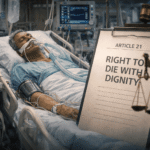
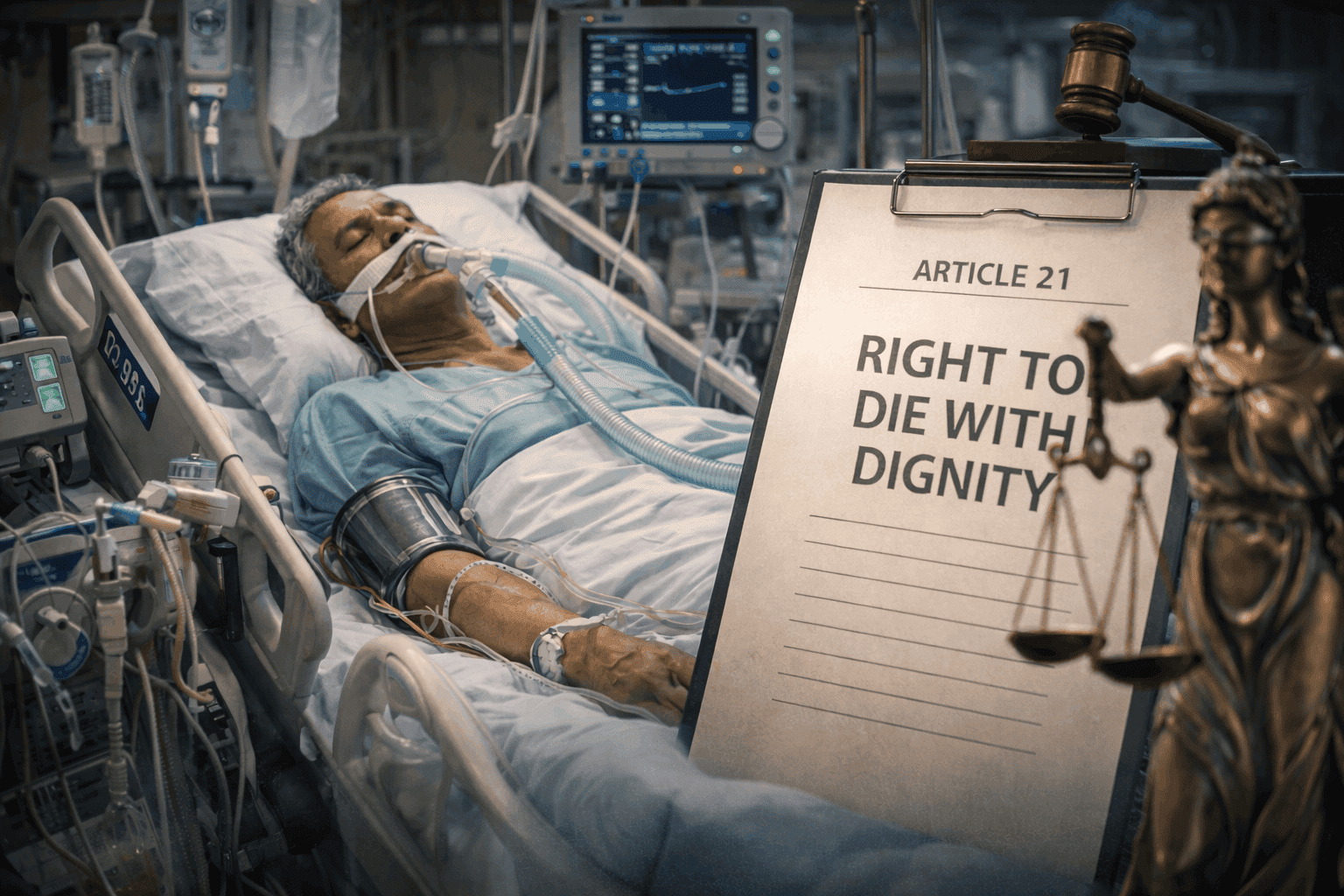
Legal Journey of Euthanasia, is so important which is depend on the fundamental quetion which regards to Article 21, which includes right to life, Whether the same article also includes Right to Die within it? Euthanasia has emerged as one of the most complex and emotionally charged debates in contemporary legal and medical discourse. At its core lies a fundamental question: whether an individual suffering from terminal illness or irreversible medical conditions possesses the legal right to end life with dignity. This question places two powerful constitutional and ethical principles in direct tension, the sanctity of life and the autonomy of the individual.
What is Euthanasia? Understanding the Concept, Types, and Global Legal Debate
In India, the debate over euthanasia did not initially arise through legislative action but through judicial intervention. The absence of comprehensive statutory regulation forced the judiciary to grapple with difficult moral, medical, and constitutional issues related to end-of-life care. Consequently, the Supreme Court of India gradually developed a legal framework governing euthanasia through landmark constitutional judgments.
Over the past three decades, Indian constitutional jurisprudence has evolved significantly on this issue. Beginning with the rejection of a general right to die in Gian Kaur v. State of Punjab, the courts later recognised limited forms of passive euthanasia in Aruna Ramachandra Shanbaug v. Union of India. This evolution reached a major constitutional milestone in Common Cause v. Union of India, where the Supreme Court affirmed that the right to life under Article 21 includes the right to die with dignity in specific medical circumstances.
This article traces the judicial evolution of euthanasia law in India and examines how constitutional interpretation gradually reshaped the relationship between life, dignity, autonomy, and medical ethics.
2. Right to Life vs Right to Die
The Indian Constitution guarantees the Right to Life and Personal Liberty under Article 21. Over time, the Supreme Court has interpreted Article 21 expansively to include numerous rights essential for living with dignity, including the right to privacy, health, and bodily integrity.
However, whether Article 21 also includes a “right to die” has long been a contentious issue. Early judicial decisions struggled to reconcile the constitutional protection of life with claims that individuals suffering from unbearable medical conditions should have the right to end their lives.
A key complication arises from the Indian Penal Code. Section 309 IPC criminalised attempted suicide, while Section 306 IPC criminalises abetment of suicide. These provisions historically reflected the view that suicide represents a social and moral wrong rather than an exercise of personal autonomy.
The constitutional debate therefore centred on whether the right to life could logically include the right to end one’s life. Critics of euthanasia argued that recognising such a right would undermine the sanctity of life and expose vulnerable individuals to coercion or abuse. Supporters, however, argued that forcing individuals to endure prolonged suffering violates human dignity.
This constitutional dilemma reached the Supreme Court directly in Gian Kaur v. State of Punjab (1996).
3. Gian Kaur v. State of Punjab (1996)
The case of Gian Kaur v. State of Punjab, (1996) 2 SCC 648, became the first major constitutional decision addressing the relationship between the right to life and the right to die.
Facts of the Case
The appellants, Gian Kaur and her husband Harbans Singh, were convicted under Section 306 IPC for abetting the suicide of their daughter-in-law. They challenged the constitutional validity of Section 306 by arguing that if suicide itself were recognised as part of the right to life under Article 21, then assisting suicide could not be criminalised.
This argument relied on an earlier Supreme Court decision in P. Rathinam v. Union of India (1994), which had briefly suggested that the right to die might fall within Article 21.
Supreme Court’s Decision
A Constitution Bench of the Supreme Court rejected this argument and overturned the reasoning in P. Rathinam. The Court held that the right to life under Article 21 cannot logically include the right to die, because life and death represent opposite concepts.
The Court observed that suicide is fundamentally inconsistent with the constitutional protection of life. Therefore, the criminal provisions relating to suicide and abetment of suicide remained constitutionally valid.
Important Observation
Despite rejecting a general right to die, the Court made a crucial observation that later became highly significant. It noted that the concept of “dying with dignity” may differ from suicide in situations involving terminal illness or natural death.
This remark created the conceptual foundation for later euthanasia debates. Although the Court did not recognise euthanasia at the time, it left open the possibility that end-of-life medical decisions could be treated differently from suicide.
4. Aruna Ramachandra Shanbaug v. Union of India (2011)
The euthanasia debate resurfaced dramatically in Aruna Ramachandra Shanbaug v. Union of India, (2011) 4 SCC 454.
Background of the Case
Aruna Shanbaug was a nurse working at KEM Hospital in Mumbai. In 1973, she was brutally assaulted and strangled by a hospital attendant. The attack deprived her brain of oxygen, leaving her in a persistent vegetative state (PVS) for over three decades.
In 2009, journalist Pinki Virani filed a petition before the Supreme Court seeking permission to withdraw life-sustaining treatment, arguing that continuing such treatment violated Aruna Shanbaug’s dignity.
Legal Issues
The case raised unprecedented questions:
- Can courts permit euthanasia in India?
- Is withdrawing life support legally permissible?
- Who should decide such matters when the patient cannot express consent?
Distinction Between Active and Passive Euthanasia
The Supreme Court made a clear distinction between active euthanasia and passive euthanasia.
Active euthanasia involves deliberately administering substances or actions that cause death. The Court held that active euthanasia remains illegal and could amount to homicide under Indian criminal law.
Passive euthanasia, however, involves withdrawing or withholding life-sustaining treatment, allowing the patient to die naturally.
Court’s Decision
The Supreme Court refused to allow withdrawal of life support in Aruna Shanbaug’s case because hospital staff wished to continue her care. However, the Court made a historic ruling by permitting passive euthanasia in India under strict safeguards.
Judicial Guidelines
Because India lacked legislative regulation, the Court issued interim guidelines, including:
- Approval from the High Court
- Evaluation by an independent medical board
- Consideration of the patient’s best interests
These safeguards were intended to prevent misuse while allowing compassionate end-of-life decisions.
5. Doctrine of Passive Euthanasia Development
The Shanbaug judgment fundamentally altered India’s legal landscape by recognising the legitimacy of passive euthanasia in exceptional circumstances.
The Court reasoned that allowing the withdrawal of artificial life support does not necessarily amount to killing a patient. Instead, it permits the natural process of dying when medical treatment merely prolongs suffering without reasonable hope of recovery.
This reasoning aligned Indian law with emerging international bioethical principles, particularly the distinction between killing and letting die.
Importantly, the judgment reframed the debate. The issue was no longer about intentionally ending life but about respecting the natural process of death when continued treatment offers no meaningful benefit.
However, the Court emphasised that such decisions must be carefully supervised to prevent abuse.
6. Common Cause v. Union of India (2018)
The constitutional debate reached its most significant milestone in Common Cause v. Union of India, (2018) 5 SCC 1.
Constitutional Questions
The petition raised several issues:
- Does Article 21 include the right to die with dignity?
- Can individuals refuse life-sustaining medical treatment?
- Should advance medical directives be legally recognised?
Major Rulings
A Constitution Bench of the Supreme Court delivered a unanimous judgment affirming that the right to life under Article 21 includes the right to die with dignity.
The Court recognised that forcing individuals to undergo unwanted medical treatment during terminal illness may violate personal autonomy and dignity.
Recognition of Living Wills
The Court legally recognised Advance Medical Directives, commonly known as living wills. A living will allows individuals to specify in advance that they do not wish to receive life-sustaining treatment if they become terminally ill or incapable of expressing consent.
Procedural Safeguards
To prevent misuse, the Court introduced safeguards such as:
- Certification by medical boards
- Confirmation by judicial magistrates
- Verification of the patient’s wishes
These procedures aimed to balance autonomy with protection of vulnerable individuals.
7. Living Wills
A living will is a written document in which a person expresses medical preferences regarding end-of-life treatment.
Such directives become important when patients lose the capacity to communicate due to severe illness, coma, or vegetative state.
The Supreme Court recognised that respecting advance directives strengthens patient autonomy and dignity.
The procedural safeguards ensure that:
- Decisions reflect the genuine wishes of the patient
- Medical professionals act responsibly
- Family members are consulted where appropriate
Through this framework, end-of-life decision-making gradually shifted from court-controlled procedures toward patient-centred medical ethics.
8. The Right to Die with Dignity
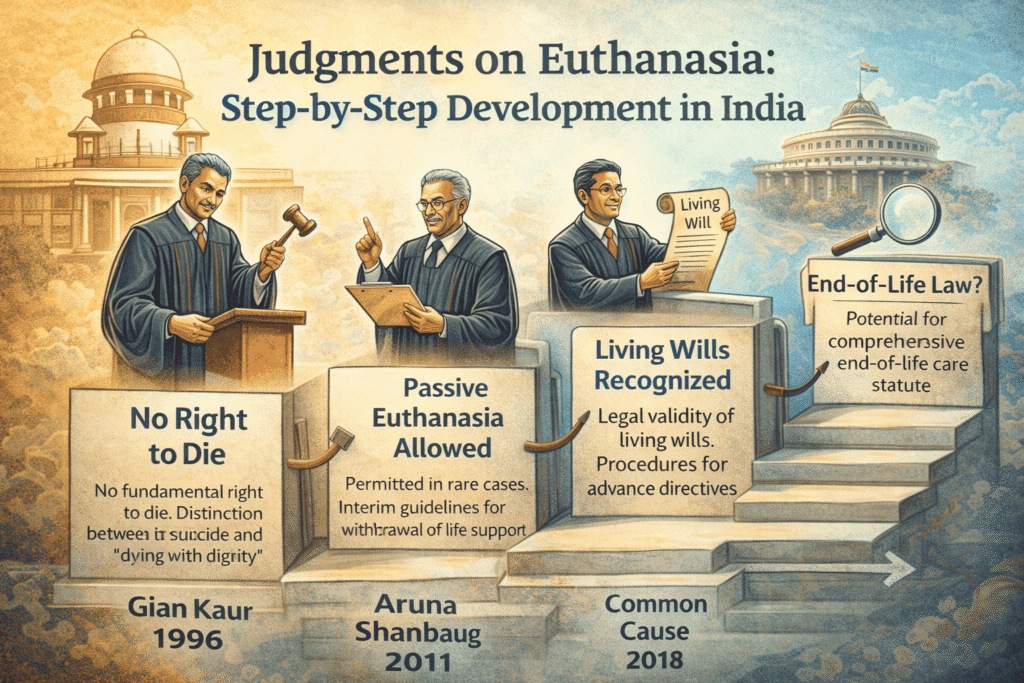
The development of euthanasia law in India reflects a gradual and cautious judicial evolution.
Three major stages can be identified:
First Stage: Rejection of Right to Die
Gian Kaur (1996) rejected a general right to die and upheld criminal prohibitions on suicide and assisted suicide.
Second Stage: Limited Acceptance of Passive Euthanasia
Aruna Shanbaug (2011) recognised passive euthanasia under judicial supervision.
Third Stage: Constitutional Recognition of Dignified Death
Common Cause (2018) affirmed the right to die with dignity and legalised living wills.
This progression demonstrates a broader shift in constitutional morality. The judiciary moved from a strictly protective approach toward life to a more nuanced recognition of human dignity, autonomy, and compassionate medical care.
9. Continuing Legal Challenges
Despite these developments, significant legal challenges remain.
First, India still lacks comprehensive parliamentary legislation regulating euthanasia. Judicial guidelines, while important, cannot substitute for detailed statutory frameworks.
Second, the implementation of living wills remains complex. Many hospitals lack awareness or institutional protocols for recognising advance directives.
Third, concerns about misuse continue to persist, particularly in a society where vulnerable individuals may face economic or social pressure.
Finally, clear medical protocols are needed to guide doctors when dealing with end-of-life decisions.
As a result, the judiciary continues to play a crucial role in shaping the practical application of euthanasia law.
10. Conclusion
The legal journey of euthanasia in India illustrates how constitutional interpretation can gradually reshape complex ethical and medical questions.
Beginning with the rejection of a general right to die in Gian Kaur v. State of Punjab, the Supreme Court cautiously recognised passive euthanasia in Aruna Ramachandra Shanbaug v. Union of India. This evolution culminated in Common Cause v. Union of India, where the Court affirmed that the right to life under Article 21 includes the right to die with dignity in certain circumstances.
These judgments reflect a deeper recognition that dignity remains central to constitutional protections throughout the entire span of human life, including its final stages.
However, the legal framework remains incomplete without comprehensive legislative reform and improved medical infrastructure.
The debate surrounding euthanasia therefore continues to evolve.
Quick Summary
- Indian euthanasia law evolved primarily through Supreme Court judgments rather than legislation.
- Gian Kaur (1996) rejected a general right to die but hinted at dignified death in terminal illness.
- Aruna Shanbaug (2011) permitted passive euthanasia under strict judicial safeguards.
- Common Cause (2018) recognised living wills and the right to die with dignity under Article 21.
- Despite progress, India still requires comprehensive legislation and clearer medical protocols for end-of-life decisions.
Life, Law and Dignity : Understanding Euthansia Series
The next article in this series would find as below:
- What is Euthanasia? Understanding the Concept, Types, and Global Legal Debate
- The Legal Journey of Euthanasia in India: From Aruna Shanbaug to the Right to Die with Dignity, The Legal Evolution of Euthanasia in India
- Vegetative State, Living Wills, and Medical Ethics: When Does Life-Sustaining Treatment Become Futile?
- The Harish Rana Case and Passive Euthanasia in India: A New Chapter in End-of-Life Law
- The Future of End-of-Life Law in India: Should Parliament Enact a Comprehensive Euthanasia Law?
References
- Tom L. Beauchamp & James F. Childress, Principles of Biomedical Ethics (7th ed. 2013).
- Helga Kuhse & Peter Singer, Bioethics: An Anthology (2d ed. 2006).
- Margaret Pabst Battin, Ending Life: Ethics and the Way We Die (2005).
- Jonathan Herring, Medical Law and Ethics (9th ed. 2021).
- Emily Jackson, Medical Law: Text, Cases, and Materials (5th ed. 2019).
- James Rachels, Active and Passive Euthanasia, 292 New Eng. J. Med. 78 (1975).
- John Keown, Euthanasia, Ethics and Public Policy, 11 Cambridge Q. Healthcare Ethics 345 (2002).
- Margaret Pabst Battin, Physician-Assisted Suicide and Euthanasia, 7 J. Med. Ethics 79 (1981).
- World Health Organization, Ethics and Health: End-of-Life Care (World Health Org. 2017).
- Government of Canada, Medical Assistance in Dying (MAiD) Legislation, Department of Justice (2016).
- Aruna Ramachandra Shanbaug v. Union of India, (2011) 4 S.C.C. 454 (India).
- Common Cause v. Union of India, (2018) 5 S.C.C. 1 (India).
- India Const. art. 21.
- Indian Kanoon, https://indiankanoon.org.