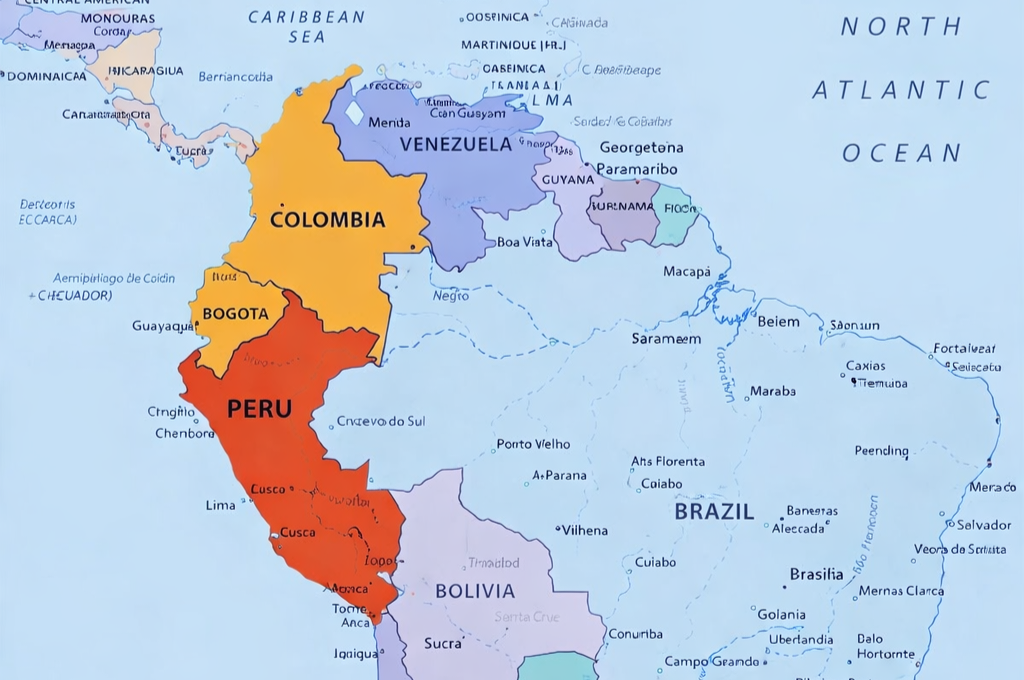
In May 1948, Peru experienced a significant political upheaval. Following contested elections and increasing social unrest, a rebellion erupted against the regime of President José Luis Bustamante y Rivero. Victor Raúl Haya de la Torre, a prominent Peruvian political leader and head of the American Popular Revolutionary Alliance (APRA), became a central figure in the conflict. When government forces sought his arrest on charges related to inciting the rebellion, Haya de la Torre sought refuge.
On July 5, 1948, Haya de la Torre entered the Colombian diplomatic legation in Lima to escape arrest by Peruvian authorities. Colombia granted him diplomatic asylum, a form of protection allowing individuals to take refuge in a diplomatic mission. Haya de la Torre remained inside the Colombian Legation for over four years, during which time Peru repeatedly demanded his surrender.
Tension escalated between Colombia and Peru. Colombia maintained that, under applicable international agreements, it had a right to grant asylum in such circumstances. Peru contended that the asylum was unlawful and demanded Haya de la Torre’s immediate handover. With bilateral negotiations failing, Colombia brought the dispute to the International Court of Justice (ICJ) in 1949.
1. The Legal Issues Before the ICJ
The core legal questions were:
a) Was Colombia’s grant of asylum to Haya de la Torre lawful under international law?
b) Did Peru have any legal obligation under the relevant treaties, especially the Havana Convention on Asylum of 1928 (formally, the Convention on Asylum and the Rights and Duties of States): to recognize and comply with that asylum?
These questions raised subsidiary issues, including:
a) The interpretation and applicability of the Havana Convention.
b) Whether acts of domestic rebellion engaged the treaty’s asylum provisions.
b) Whether there was a binding regional rule of international law governing diplomatic asylum.
2. The Havana Convention and Its Interpretation
The Havana Convention, concluded within the framework of the Fifth International Conference of American States, was designed to standardize asylum practices in Latin America. Key provisions included:
i. Definitions of what constituted political and criminal offenses.
ii. The conditions under which diplomatic asylum could be granted.
iii. The obligations of requested States (those on whose territory asylum is sought) to accept or refuse such asylum.
Colombia argued that under the Convention, diplomatic asylum is permissible when the individual fears political persecution. Colombia maintained that Haya de la Torre’s situation, involving a political rebellion, was precisely such a case. Moreover, Colombia asserted that an established regional custom existed among American States permitting diplomatic asylum on these grounds.
Peru countered that:
i. Haya de la Torre had not been accused of political rather than ordinary criminal offenses.
ii. The Convention’s provisions did not clearly apply to internal rebellions or were not binding as an international right for asylum seekers.
iii. There was no uniform regional custom that obligated Peru to recognize Colombia’s asylum decision.
3. Jurisdiction of the ICJ
The ICJ first had to establish that it had jurisdiction. The dispute was grounded in the interpretation and application of a treaty; the Havana Convention; to which both States were parties. The Court confirmed its jurisdiction under Article 36 of its Statute and the relevant compromissory clauses of the Convention.
4. Key Legal Findings of the ICJ (1950 Judgment)
a. Existence of a Regional Custom of Diplomatic Asylum
The ICJ examined State practice and opinio juris (a sense of legal obligation) among American States. It found:
i. Evidence of instances where States had granted and recognized diplomatic asylum.
ii. However, State practice was not sufficiently uniform or consistent to demonstrate a binding regional custom that would impose an obligation on Peru to accept Colombia’s grant of asylum.
The Court concluded that while diplomatic asylum had been practiced, it was not an established rule of international law binding on Peru outside the express terms of a treaty.
b. Interpretation of the Havana Convention
The Court analyzed whether the Convention created a clear obligation on Peru to recognize the asylum in this specific case. On this point, the Court held:
i. The Convention required consulted decision-making between the asylum‑granting State and the requested State.
ii. The Convention did not automatically obligate Peru to accept the grant of asylum.
iii. Crucially, even if the Convention were applicable, the circumstances concerning Haya de la Torre, inked to an internal rebellion, did not fall neatly within the treaty’s clearly defined categories of political offenses.
Thus, the regime of the Havana Convention did not impose a legal duty on Peru to accept or acquiesce in Colombia’s asylum decision in this instance.
c. Consequences and Obligations
Because the Court found no binding regional custom and no clear treaty obligation under the Havana Convention:
i. Colombia had not established that Peru was bound by international law to recognize the asylum.
ii. However, the Court also avoided dictating a specific outcome about the release or surrender of Haya de la Torre, instead emphasizing that the two States should negotiate in good faith to resolve the situation.
5. Significance and Impact of the Decision
a. Clarification of Diplomatic Asylum Law
The decision is foundational in international law for several reasons:
i. It clarified that diplomatic asylum is not a universally recognized right or obligation in international law independent of specific treaty commitments.
ii. It highlighted that the existence of regional treaties alone is insufficient to establish customary international law without consistent State practice and opinio juris.
b. Treaty Interpretation Principles
The case illustrated careful judicial interpretation of treaties, balancing text, context, and practice. The ICJ underscored that when a treaty’s language is ambiguous or does not clearly impose obligations, it is not appropriate to assume binding legal duties.
c. State Sovereignty and Political Offenses
By situating asylum within a framework that gives significant weight to State sovereignty and domestic legal classifications (e.g., political versus criminal offenses), the Court reaffirmed the primacy of consent and clarity in international legal obligations.
d. Diplomatic and Good‑Faith Negotiations
Although the Court did not grant Colombia’s principal request, it urged both parties to continue negotiations. This reflects the ICJ’s role not only as an adjudicator but as a promoter of peaceful dispute resolution.
6. Conclusion
The Asylum Case (Colombia v. Peru) remains a landmark ICJ judgment concerning diplomatic asylum and treaty interpretation. It determined that Colombia’s grant of asylum to Victor Raúl Haya de la Torre was not unlawful per se but was not protected by a binding international obligation under the Havana Convention or customary international law. As a result, Peru was not legally obliged to recognize or accept the asylum under the treaty. The decision emphasized the need for clear legal bases for asylum obligations and contributed significantly to the jurisprudence on diplomatic asylum, treaty law, and State responsibility.
Quick Summary
- The case arose when Victor Raúl Haya de la Torre took asylum in the Colombian embassy during a political rebellion in Peru.
- The ICJ examined whether Colombia’s grant of diplomatic asylum was lawful and binding on Peru under international law.
- The Court held that no consistent regional custom existed to make diplomatic asylum legally binding on Peru.
- The Havana Convention did not impose a clear obligation on Peru to recognize or accept the asylum.
- The ICJ emphasized state sovereignty and encouraged both countries to resolve the dispute through good faith negotiations.